
Thailand prepares rules and workforce for small nuclear reactors
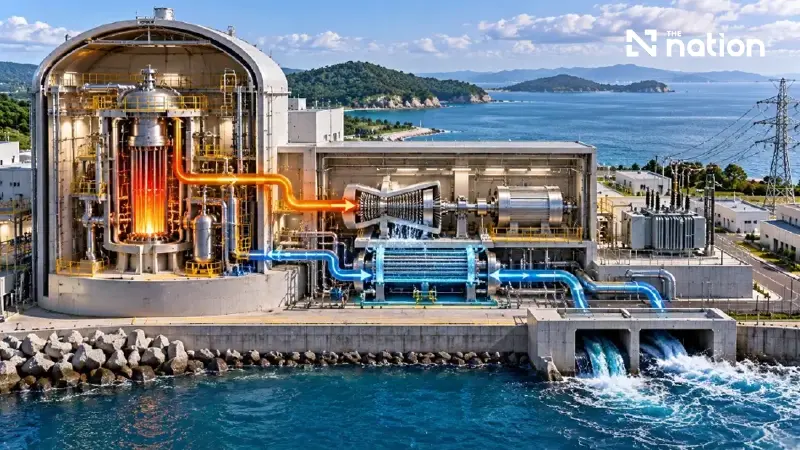


Thailand prepares SMR rules and specialist staff for potential nuclear capacity of up to 9,000 MW by 2050 under the draft PDP 2026.
- Thailand is developing new, detailed regulations for Small Modular Reactors (SMRs) to supplement existing laws, focusing on site assessment, module manufacturing, and radioactive waste management.
- To build a specialized workforce, the government is creating a staffing framework, has established a training institute for regulatory personnel, and is drafting a Human Resource Development Plan.
- Preparations also include a new draft law on civil liability for nuclear damage and establishing financial arrangements to cover long-term safety obligations like waste management and decommissioning.
Thailand is preparing additional regulations and specialist personnel to oversee small modular nuclear reactors (SMRs), as its nuclear regulator plans for potential capacity of up to 9,000 megawatts by 2050 under the country’s draft power development plan.
Dr Rungreung Kitphati, secretary-general of the Office of Atoms for Peace (OAP), said Thailand already has legislation governing nuclear facilities throughout their operational lives. However, the range of SMR technologies requires more detailed regulations, alongside the development of technical expertise to support oversight.
The preparations encompass regulatory staffing, site assessment, reactor module manufacturing, radioactive waste management and financial arrangements covering long-term safety obligations.
Workforce planning follows national readiness assessment
Thailand’s preliminary self-assessment under the International Atomic Energy Agency’s (IAEA) Milestones Approach examined 19 areas of nuclear infrastructure development.
Human resource development was among six areas identified as requiring further work. Three other areas—national position, project management, and funding and financing—were classified as needing significant and urgent action.
The OAP has prepared a staffing framework for nuclear power regulation and established an institute for developing nuclear and radiation regulatory personnel, with an organisational status equivalent to a division.

It is also drafting a long-term Human Resource Development Plan (HRDP). The potential 9,000 MW capacity under the draft Power Development Plan, known as PDP 2026, provides the framework for preparing that regulatory workforce.
SMR designs require more detailed rules
Rungreung explained that regulatory readiness must precede SMR deployment. The necessary foundations include statutory powers, rules for procuring nuclear components, an independent regulatory structure, adequate budgets and technically qualified personnel.
Thailand’s Nuclear Energy for Peace Act 2016 is already in force. A separate draft law on civil liability for nuclear damage is in the process of being submitted to the Cabinet.
He said the two laws would cover almost all aspects of nuclear facility regulation once the civil liability legislation takes effect.
However, SMRs are developing rapidly and take different forms, including land-based modular plants and floating nuclear power plants.
Additional ministerial regulations, OAP notifications and Nuclear Energy for Peace Commission rules are therefore needed in four areas:
- Criteria for assessing proposed sites
- Manufacturing prefabricated modules at overseas factories
- Assembling modules at their intended locations
- Managing radioactive waste from advanced reactor technologies

Financial assurance is another prerequisite. Rungreung highlighted the need for funds to manage radioactive waste and spent nuclear fuel, together with a decommissioning fund, so that resources remain available for safety obligations throughout a project’s life and eventual closure.
Five approval stages cover the project lifecycle
The 2016 Act provides a five-stage approval process for nuclear facilities:
- Site-use licence: Permission to use a location for a nuclear facility.
- Construction licence: Authorisation to build the facility.
- Fuel-loading and reactor-testing permit: Separate approval to load nuclear fuel and test reactor operations, distinct from the main licences.
- Operating licence: Permission to operate the facility.
- Decommissioning licence: Authorisation to decommission it.
Ministerial regulations specify the documents, requirements and technical criteria applicants must satisfy at each stage.
Overseas certification can inform Thai assessments
Factory production of SMR components before on-site assembly can shorten the time needed for engineering inspections at the project location, according to Rungreung.
Thailand can also draw on design certification and regulatory experience from the countries supplying the technology to help reduce assessment time.
The OAP would focus on environmental conditions and site-specific safety factors in Thailand.
Rungreung stressed that the agency acts as an independent regulator, not as an investor or project developer. It also serves as the secretariat of the Nuclear Energy for Peace Commission.
Bangkok workshop to examine regulatory readiness
These preparations will feature at the IAEA–United States Regional Workshop on Scaling SMR Deployment: From FOAK to NOAK Financing Models, scheduled for November 2–6, 2026, at the Best Western Chatuchak Hotel in Bangkok.
The OAP, under the Ministry of Higher Education, Science, Research and Innovation, is organising the workshop with the IAEA’s Planning and Economic Studies Section (PESS), the US Department of Energy (DOE), Thailand’s Energy Policy and Planning Office (EPPO), the Electricity Generating Authority of Thailand (EGAT) and PTT Public Company Limited.
The programme on Tuesday, November 3, will address ownership, project preparation and regulatory readiness.
Dr Neal Mann and Dr Nicolas Stauff, specialists in energy systems and nuclear engineering at Argonne National Laboratory (ANL), will discuss site selection and feasibility studies. Representatives of the World Bank and Asian Development Bank (ADB) will examine how multilateral development banks can support project readiness.
Elina Teplinsky, global energy industry leader at the law firm Pillsbury Winthrop Shaw Pittman, will address licensing approaches, institutional capacity and international cooperation.
A closing panel will consider ownership and financing structures suited to Thailand and the region, bringing together Thai representatives and the International Finance Corporation (IFC). Ted Jones of the Nuclear Energy Institute (NEI) will moderate the discussion.
A further panel on Thursday, November 5, will examine the division of responsibilities among governments, developers, regulators and development finance institutions, from planning through project delivery. It will also consider areas where those responsibilities overlap or remain unclear.
