
Small modular reactors shape Thailand’s clean-energy future
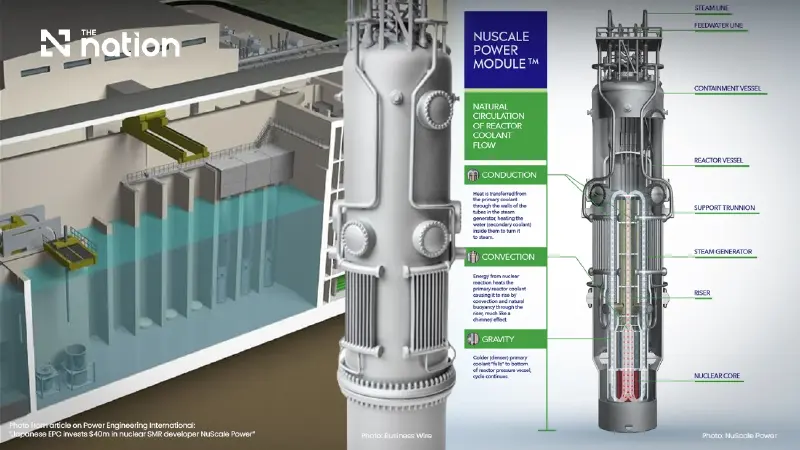


Thailand is weighing SMRs as a stable low-carbon power source, balancing rising clean-energy demand with safety, waste management and public trust.
- Thailand is considering small modular reactors (SMRs) as a stable, low-carbon energy source to complement renewables like solar and wind, thereby enhancing energy security and reducing reliance on imported gas.
- SMRs are smaller, factory-built nuclear reactors with advanced safety features, seen as ideal for providing continuous power to data centres and industrial users amid rising demand for clean electricity.
- The Thai government intends to include SMRs in its upcoming Power Development Plan, with initial proposals for 2,000–4,000MW of capacity to be developed within the next ten years.
- Major challenges for adopting the technology include establishing a long-term nuclear waste management strategy and gaining public confidence and understanding of modern nuclear safety standards.
As the world pushes towards net-zero emissions, Thailand faces a more complex energy challenge than simply producing more clean power. The country must also ensure its electricity supply remains stable, affordable and secure as renewable energy expands but remains dependent on weather conditions.
That is why small modular reactors (SMRs) are returning to Thailand’s energy debate. Rather than replacing solar, wind or other renewables, they are being considered as a possible low-carbon partner that can generate electricity continuously, support the grid and reduce exposure to volatile imported fuels.
Krungsri Research has described SMRs as a potential “supporting force” for Thailand’s clean-energy infrastructure as demand for green electricity rises and global energy risks intensify.
Assoc Prof Dr Jessada Denduangboripant of Chulalongkorn University’s Department of Biology said the discussion should begin with the reality that energy demand will continue to grow.
“We definitely need more energy, and we also need clean energy,” he said. “Solar and wind are good, but they are not very stable and are available only at certain times.”
A smaller reactor for a more complex age
Nuclear power has been used commercially since the 1950s, and reactor technology has evolved through several generations. The International Energy Agency says nuclear power supplies just under 10% of global electricity and is the second-largest source of low-emissions power after hydropower.
Public concern, however, continues to be shaped by major accidents such as Chernobyl in 1986 and Fukushima in 2011, particularly over radioactive releases, emergency response and nuclear waste.
SMRs are generally built in smaller units, often with a capacity of up to about 300 megawatts per module. Their components can be manufactured in factories before being transported to the project site. They still use nuclear fission to generate heat, but differ in scale, modular construction and, in many newer designs, the use of passive safety systems that can remove heat without external electricity or immediate operator action.
The technology remains at an early stage globally. The Nuclear Energy Agency reported that seven SMR projects were operating or under construction in 2025, with more than 50 undergoing licensing. Operating examples include Russia’s floating Akademik Lomonosov plant and China’s HTR-PM project.
Jessada said the smaller physical footprint and newer safety features were among the technology’s main attractions, alongside its ability to provide continuous low-carbon power. He also pointed to data centres and industrial users as examples of facilities that need large amounts of reliable electricity at individual sites.
Safety standards remain strict
Prof Dr Somboon Rasmee, head of Chulalongkorn University’s Department of Nuclear Technology, said SMRs remain subject to the same fundamental nuclear safety principles as large reactors.
“The safety standards are not different from those for large nuclear power plants,” he said, referring to International Atomic Energy Agency principles, including defence-in-depth measures covering design, site selection, accident response and measures to limit public exposure.
Newer SMRs, however, have an advantage in passive safety, he said, because some systems can respond without relying on external electricity or an operator’s decision.
Somboon also cautioned against presenting the technology as risk-free.
“SMRs do have risks. The question is how those risks are controlled,” he said. Their smaller generating capacity can make the potential impact of an accident more manageable than at a large nuclear plant, he added.
Site selection would be crucial. Nuclear facilities must be assessed for exposure to earthquakes, flooding, fire and other external hazards, while access to cooling is another major consideration. Sites with unacceptable risks or the potential to have excessive impacts on nearby communities should be ruled out.
Thailand’s policy signal
Thailand has explored nuclear power for decades, but previous plans were delayed or abandoned after the discovery of natural gas in the Gulf of Thailand and, later, following the Fukushima disaster.
The idea returned in the draft Power Development Plan 2024, which included 600MW of SMR capacity at two sites. Attention has since shifted to PDP2026.
Wattanapong Kurovat, director-general of the Energy Policy and Planning Office, said on June 25, 2026, that PDP2026 would include SMRs within a 10-year timeframe.
Initial planning points to plants with capacities of 300–600MW and combined capacity of around 2,000–4,000MW, with the Electricity Generating Authority of Thailand (EGAT) expected to lead the first phase. Private-sector participation could be considered later, depending on the policy direction.
Waste remains a long-term test
Somboon said Thailand already has experience in handling radioactive waste from industry, medicine and other uses through institutions including the Thailand Institute of Nuclear Technology and the Office of Atoms for Peace. Spent nuclear fuel from a power reactor, however, would be a different challenge.
Thailand would need to strengthen its personnel, equipment and long-term management capabilities before operating a nuclear power plant, he said. Plant operators would carry primary responsibility, while specialist agencies and regulators would also have roles in spent-fuel management and safety oversight.
Technically, spent fuel can be reprocessed to recover uranium and plutonium, a process used in several countries, but Somboon said Thailand would need to assess the technology, economics and future options carefully.
“The public needs a clear explanation of where spent fuel will ultimately go and how it will be managed over the long term,” he said.
The road ahead
Krungsri Research sees rising clean-energy demand and energy-security concerns as two forces supporting the case for SMRs. Technology companies including Google, Microsoft and Amazon Web Services have announced data-centre and cloud investments in Thailand, increasing demand for reliable clean electricity around the clock. Thailand has also brought forward its net-zero target to 2050.
Energy security is another factor. Thailand relies heavily on imported liquefied natural gas, with around one-quarter of its LNG imports coming from the Middle East. SMRs use uranium sourced from several regions, potentially giving Thailand another option for reducing exposure to geopolitical disruption and fuel-price volatility.
EGAT has been studying SMR technologies, potential sites and workforce development in preparation for possible future projects. It has also highlighted the need for public understanding and participation.
For Jessada, that public dialogue may determine whether the technology moves beyond the planning stage.
“The bigger issue is creating understanding among the public,” he said. “The technology has developed a long way, but people need the opportunity to learn what it is and how it works.”
Somboon offered a similar test: Thailand should weigh the benefits against risks that are technically manageable, socially acceptable and environmentally responsible.
The SMR debate is therefore about more than whether nuclear power can produce low-carbon electricity. It is also about whether Thailand can build the institutions, safety systems, waste management strategy and public confidence needed to make that option credible.
