
Thailand’s draft PDP targets first 300MW SMR by 2037
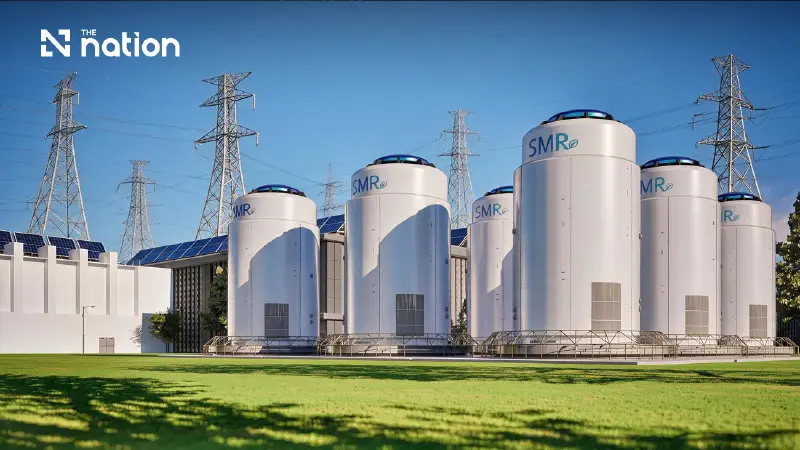


Thailand’s draft PDP2026 targets a 300MW small modular reactor for 2037 and total SMR capacity of about 9,000MW by 2050.
- Thailand's draft Power Development Plan 2026 proposes introducing the nation's first 300-megawatt small modular reactor (SMR) into the power system by 2037.
- This 2037 target for the initial SMR is a consistent feature across all four electricity-supply scenarios currently being considered in the draft plan.
- The first SMR is projected to supply 1% of total electricity generation in 2037, with a long-term goal of expanding SMR capacity to 9,000MW by 2050.
- The technology is intended to provide stable, clean baseload power and replace some existing fossil-fuel plants as they are retired from service.
Thailand plans to bring its first 300-megawatt small modular reactor (SMR) into the national power system in 2037 under all four options being prepared for the draft Power Development Plan 2026, or PDP 2026.
The PDP drafting subcommittee concluded the four electricity-supply scenarios at a meeting on Monday (August 17). Covering new power demand from 2026 to 2050, each option carries different costs, fuel proportions and strategic priorities.
The scenarios will be presented for public consultation in early September. Feedback will then be used to revise the draft before it is submitted to the National Energy Policy Council for consideration towards the end of 2026.
All four scenarios include SMRs as part of Thailand’s future power system, with total capacity targeted at about 9,000MW by the end of the plan in 2050.
The first 300MW plant would enter the system in 2037, when SMRs would account for about 1% of total electricity generation. The technology is intended to provide stable clean baseload power and replace some existing fossil-fuel plants as they are gradually retired.
Base case retains gas during energy transition
An Energy Ministry source revealed that the base case would continue to rely primarily on natural gas during the energy transition.
The scenario includes about 24,500MW of gas-fired capacity covered by power-purchase agreements, alongside 28,890MW of solar power and 10,360MW of wind capacity.
SMRs would initially account for 1% of total electricity generation in 2037. Their share would later rise to 5% before reaching 18% from 2045 until the end of the plan in 2050.
By 2050, clean energy would account for 65% of the generation mix, comprising 42% renewable energy, 18% SMRs and 5% from other new technologies. Fossil fuels would make up the remaining 35%.
This would compare with the current mix, in which fossil fuels account for about 75% and renewable energy for 24%.

The base case would also require about 54,500MW, or approximately 218,000 megawatt-hours, of battery energy storage systems (BESS) to help maintain grid stability.
The second scenario would retain the same basic fuel mix as the base case but incorporate the cost of carbon capture and storage (CCS) into the cost of electricity generated from fossil fuels.
The aim would be to ensure that retaining a 35% fossil-fuel share did not conflict with Thailand’s target of achieving net-zero greenhouse gas emissions by 2050.
Renewables-led scenario raises clean-energy share
The third scenario, described as “Net Zero GHG by RE”, would rely more heavily on renewable energy and would not use CCS.
Under this option, gas-fired capacity would be reduced to 16,800MW, while solar capacity would be expanded to 61,300MW and wind power to 52,700MW.
The source put the clean-energy share at 89% by the end of the plan, comprising 72% renewable energy and 16% SMRs. Fossil fuels would fall to 11%.
The large volume of variable renewable generation would require investment in 55,000MW, or 220,000MWh, of battery storage to maintain the stability of the power system.
The fourth scenario would seek to maximise the use of available domestic and regional resources, particularly natural gas from the Gulf of Thailand and imports from Myanmar, while reducing reliance on liquefied natural gas.
This option would combine gas, CCS and renewable energy. New capacity would include about 18,900MW from natural gas, 40,890MW from solar power and 23,360MW from wind, supported by 55,000MW, or 220,000MWh, of battery storage.
The source put clean energy at 73% of the generation mix, comprising 54% renewables and 17% SMRs, while fossil fuels would account for 27%.
The scenario is intended as a middle path, balancing the continued use of available natural gas with the transition towards cleaner energy.
SMRs would account for 1% of generation in 2037, rise to 13% in 2045 and reach 17% by 2050.
Gas remains central during first phase
The four scenarios would have broadly similar fuel structures during what the draft describes as its first 10-year phase, from 2026 to 2037.
Under the lower-demand forecast, electricity demand would reach about 54,192MW in 2037, with annual consumption of approximately 322.302 billion kilowatt-hours.
Under the higher-demand forecast, demand would rise to 57,273MW, with annual electricity consumption of about 341.207 billion kWh.
New generating capacity added during the period would total about 36,400MW. This would comprise around 9,100MW of fossil-fuel capacity, 24,300MW of solar power, 2,700MW of wind power and the first 300MW SMR.
The draft separately puts the corresponding shares of electricity generation at about 29% from fossil fuels, 34% from solar power, 5% from wind and 1% from the SMR. About 14,500MW of battery storage would also be installed to support renewable-energy stability.
No new gas-fired plants planned in first phase
Despite the continued role of fossil fuels, the draft does not include the construction of new gas-fired or coal-fired power plants during the first phase.
Instead, the operating lives of existing gas-fired plants would be extended by another five to 10 years. The only coal-fired capacity included would be an already approved 600MW project at Mae Moh.
“No newly built gas-fired power plants have been included in the PDP during the first 10 years because there is intense competition for gas turbines and a shortage in the market,” the Energy Ministry source explained.
“Delivery queues and production lead times are at least five years, which would take too long for new projects to be included during the first phase.
“No conclusion has yet been reached on whether the Electricity Generating Authority of Thailand will be assigned to develop the 300MW SMR scheduled to supply electricity in 2037 or whether private companies will be invited to compete through a tender.”
Retirement schedule covers major power plants
The retirement schedule cited by the source begins with capacity removed from the system from 2025, including Nam Phong Power Plant Blocks 1 and 2, with a combined capacity of 650MW; 700MW of capacity operated by Global Power Synergy; and Ratchaburi Electricity Generating Company Units 1 and 2, totalling 1,400MW.
In 2027, Bang Pakong Power Plant Unit 3, with a capacity of 576MW, and Ratchaburi Power Plant Blocks 1 to 3, totalling 2,041MW, are scheduled to be retired.
Bang Pakong Unit 4, with a capacity of 576MW, and the 713MW Glow IPP plant are due to leave the system in 2028.
Gulf Power Generation Block 1, with a capacity of 734MW, is scheduled for retirement in 2032. Its 734MW second block and Ratchaburi Power Blocks 1 and 2, totalling 1,400MW, are due to follow in 2033.
The schedule also lists the 315MW Krabi Power Plant and the 710MW first block of Chana Power Plant for retirement in 2034.
South Bangkok Power Plant Block 3 and Bang Pakong Block 5, each with a capacity of 710MW, are due to retire in 2035, followed by the 670MW first block of North Bangkok Power Plant in 2036.

TDRI calls for clearer direct power purchase plan
Dr Areeporn Asawinpongphan, an energy-policy research fellow at the Thailand Development Research Institute (TDRI), noted that the draft PDP 2026 offered several scenarios aligned with electricity-demand forecasts.
The options also provided greater fuel diversification and supported Thailand’s net-zero target, she explained.
However, Areeporn called for the electricity market to be opened further through direct power purchase agreements for renewable energy between producers and consumers. The plan should clearly specify how many megawatts would be available under the Direct PPA scheme.
“The draft PDP 2026 is ready to proceed to public consultation and is considerably better than the draft PDP 2024 that previously went through a hearing,” she noted.
“This time, several scenarios have been developed to achieve Thailand’s net-zero target and strengthen energy security, while keeping prices at a reasonable level and addressing environmental concerns. I believe PDP 2026 should be adopted within 2026.”

Dedicated state body urged for nuclear development
Assistant Professor Dr Yanin Sukjai of King Mongkut’s University of Technology Thonburi, a specialist in nuclear engineering and energy systems, supported the use of nuclear power as a source of baseload electricity to replace fossil-fuel plants.
The technology could help reduce carbon dioxide emissions, Yanin noted, but the target of bringing the first SMR into the system in 2037 might be too ambitious. Considerable uncertainty remained over whether it could be achieved in practice.
Meeting the target would require the government to overhaul its working structure and accelerate preparations as a matter of urgency.
The first priority should be to establish a state agency dedicated specifically to nuclear-power development. Thailand previously established such an office in 2011, but it was subsequently abolished after the Fukushima nuclear accident in Japan.
The government would also need to accelerate knowledge transfer and strengthen the academic capacity of universities.
A stronger knowledge base would enable the academic sector to study and analyse the project and develop evidence to support, reject or challenge important issues arising during its implementation in a comprehensive manner that was fair to all parties, Yanin explained.
Energy expert urges caution over SMR and CCS assumptions
Prof Dr Praipol Koomsup, former dean of the Faculty of Economics at Thammasat University and an independent energy academic, told Thansettakij that the draft Power Development Plan 2026, or PDP2026, sought to account for new sources of electricity demand, including electric vehicles, data centres and high-speed rail.
He noted that the projected shift in peak electricity demand to between 8pm and 9pm was likely to reflect increased EV charging and would have implications for the generating capacity required by the system.
Praipol observed that small modular reactors, or SMRs, had been included in all four scenarios, with total planned capacity of more than 9,000 megawatts.
With each SMR expected to generate 300MW, reaching that capacity would require about 30 plants. He questioned how extensively Thailand had prepared for such a programme, noting that considerable groundwork would be needed over the next decade before the first SMR could begin operating.
Preparations would have to cover legislation, regulation, costs and, most importantly, public acceptance. These factors meant that considerable uncertainty remained over SMR development, and the government should proceed cautiously, he added.
The plan also includes more than 10,000MW of battery storage, which Praipol regarded as positive provided battery prices continued to decline.
Several scenarios retain a substantial role for natural gas and assume the use of carbon capture and storage, or CCS. However, CCS has yet to become commercially viable because of its high cost, creating another source of technological uncertainty that could be even greater than that surrounding SMRs.
“When selecting among the four scenarios, the government must consider not only the technologies involved but also how their costs will affect electricity tariffs,” he explained.
“The details of the plan may not yet be fully available, but this issue must be clarified. Overall, the plan is moving in an appropriate direction by increasing the share of clean energy. Raising it above 50% would certainly be positive, and reaching 70% would be even better as Thailand moves towards net zero.”
Praipol stressed that the assumptions concerning SMRs, batteries and CCS required detailed scrutiny because of the uncertainty surrounding both the technologies and their costs.
The plan also addresses demand response, which could help manage electricity use during periods of peak demand and improve the operation of the power system.
Another issue requiring greater detail was time-of-use, or TOU, electricity pricing. Such tariffs could encourage consumers to use power during periods of lower demand, particularly when charging EVs.
By creating incentives for drivers to spread charging across different periods, the government could prevent demand from becoming excessively concentrated at a particular time and improve the overall efficiency of electricity use.
Sources: Thansettakij, Thansettakij
