
Bangkok Must Learn to 'Live With Water' to Combat Subsidence and Floods, says UN-Habitat Chief
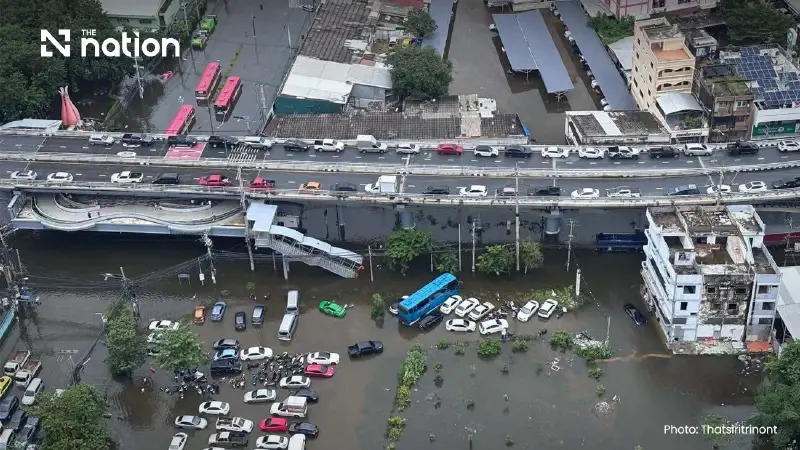


UN-Habitat’s Srinivasa Popuri tells SX2026 that Bangkok’s sinking land and flood exposure demand early investment, joined-up governance and community roles
- UN-Habitat Chief Srinivasa Popuri advises Bangkok to shift from reactive flood defenses to a proactive "living with water" strategy to combat accelerating land subsidence (at least 10mm per year) and climate change-related flooding.
- The chief advocates for early investment in preventive infrastructure, stating it offers a 1-to-10 return on investment, saving up to 10 billion baht in recovery costs for every 1 billion baht spent on prevention.
- Popuri outlined three key priorities for building resilience: fostering multi-level institutional cooperation, mobilizing private and multilateral finance, and empowering communities to participate in urban planning.
- He praised Thailand's existing initiatives, like the Baan Mankong housing program and canal upgrading projects, as exemplary models of integrated urban resilience that combine waterway management, flood mitigation, and housing improvements.
UN-Habitat’s Srinivasa Popuri tells SX2026 that Bangkok’s sinking land and flood exposure demand early investment, joined-up governance and community roles.
Bangkok must move beyond reactive flood defences and learn the art of "living with water" to safeguard its future against climate change and accelerating land subsidence, a senior United Nations official warned on Thursday (November 12).
Delivering the opening remarks at a panel discussion during Sustainability Expo 2026 (SX2026) in Bangkok, Srinivasa Popuri, chief of the UN-Habitat Multi-Country Programme Office for the Regional Office of Asia and the Pacific, urged city planners and governments across the region to transition from crisis response to proactive, climate-ready urbanisation.
Speaking under the theme "Resilient Cities: From Climate Risk to Climate-Ready Cities", Popuri noted that Bangkok—historically celebrated as the "Venice of the East" on the Chao Phraya Delta—is sinking by at least 10 millimetres every year.
This subsidence, he explained, is driven by the over-exploitation of groundwater and urban development that leaves insufficient space for water to flow and replenish aquifers.
"The question no longer is only how do we keep our water out?" Popuri told delegates at ASEAN’s largest sustainability expo, which runs from 6 to 15 November. "The question now we need to ask ourselves is: how do we make space for water so that we live in harmony with water?"

Commending Bangkok’s Efforts and Thai Models
Popuri praised the Bangkok Metropolitan Administration (BMA), led by Governor Chadchart Sittipunt, for its ongoing efforts during recent flooding, noting that while no response is perfect, the focus must remain on learning and preparing communities for earlier evacuations to minimise losses.
He also lauded Bangkok’s public parks and green spaces, describing them as vital urban "lungs" that offer natural protection against rising temperatures.
Furthermore, the UN-Habitat chief singled out Thailand’s domestic policies as exemplary blueprints for the global south. He highlighted the late King Bhumibol Adulyadej’s Sufficiency Economy Philosophy as a crucial framework for sustainable consumption and service efficiency, alongside Thailand’s community-driven Baan Mankong (Secure Housing) programme, championed by the Community Organisations Development Institute (CODI).
Popuri specifically pointed to the 4-billion-baht canal upgrading projects along Khlong Lat Phrao and Khlong Prem Prachakon as leading examples of integrated urban resilience.
By combining housing improvements, waterway management, and flood mitigation across dozens of communities, these initiatives have transformed informal settlements into safer, more inclusive neighbourhoods—a model that has already inspired urban planners across Asia, Africa, Latin America, and the Arab region.
"Thailand will have a story to tell," Popuri said, inviting Thai delegates to share these successes at the upcoming 2026 United Nations Water Conference in Abu Dhabi, co-hosted by the United Arab Emirates and Senegal from 8 to 10 December.

The Economics of Prevention
A central theme of Popuri’s address was the stark financial disparity between disaster relief and disaster prevention.
True resilience, he argued, is not measured by how effectively authorities distribute emergency food and supplies after a catastrophe, but by whether essential utilities, public services, and local economies continue to function uninterrupted during extreme weather events.
Citing a 1-to-10 return on investment, Popuri emphasised that spending 1 billion baht on preventive infrastructure can avert up to 10 billion baht in post-disaster recovery costs.
However, global climate financing continues to lag far behind urgent urban needs.
According to UN-Habitat estimates, cities worldwide require approximately US$5.4 trillion annually through 2030—totalling nearly US$20 trillion over the next four years—to build climate-resilient infrastructure.
Currently, international and national commitments secure roughly US$831 billion per year, with only a fraction reaching local adaptation projects.
"Sanitation is very expensive. Making a city resilient is very expensive. But not having sanitation and not making a city resilient is even more expensive," Popuri said. "We shall not invest in short-lived supplies when a crisis occurs but use a fraction of the same amount for preventing the disaster."

Three Pillars for Climate-Ready Cities
With less than four years remaining to achieve the UN Sustainable Development Goals (SDGs) by 2030, Popuri warned that the world must accelerate progress eightfold for safely managed drinking water and sixfold for sanitation.
Globally, more than 1.1 billion people live in slums and informal settlements, bearing the brunt of climate shocks that quickly spiral from water events into housing, health, food security, and education crises.
To bridge this gap, Popuri outlined three urgent priorities for governments and stakeholders:
• Multi-level institutional cooperation: Breaking down administrative silos between ministries responsible for drainage, housing, and urban planning.
Popuri praised Thailand’s growing adoption of "area-based planning", which treats a geographical zone as a single integrated unit, and stressed the need for cross-border cooperation—citing upstream arsenic contamination along the Thailand-Myanmar border as proof that water disregards municipal and national boundaries.
• Mobilising private and multilateral finance: Leveraging development banks, institutional investors, and global climate funds to supplement stretched public budgets.
Popuri noted that the Green Climate Fund, to which UN-Habitat was recently accredited, approved US$2.7 billion across 23 projects in just two days during a recent board meeting in Incheon, South Korea.
• Community-centred governance: Shifting away from treating vulnerable residents as passive recipients of aid, and instead empowering women, youth, and persons with disabilities to actively shape urban adaptation plans.
Guided by the UN-Habitat Strategic Plan 2026–2029, which places adequate housing, land, and basic services at the core of sustainable urban development, Popuri reaffirmed the agency’s commitment to partnering with the Thai government, the BMA, and the private sector.
"For Bangkok, the ambition should be greater than simply surviving the next flood," Popuri concluded. "Water has shaped Bangkok's past; it will shape Bangkok's future. Our task is to ensure that it does not divide those who are protected from those who are exposed but becomes a foundation for shared security, opportunity, and human dignity."
