
Thailand upskills vocational talent for EV and AI industries
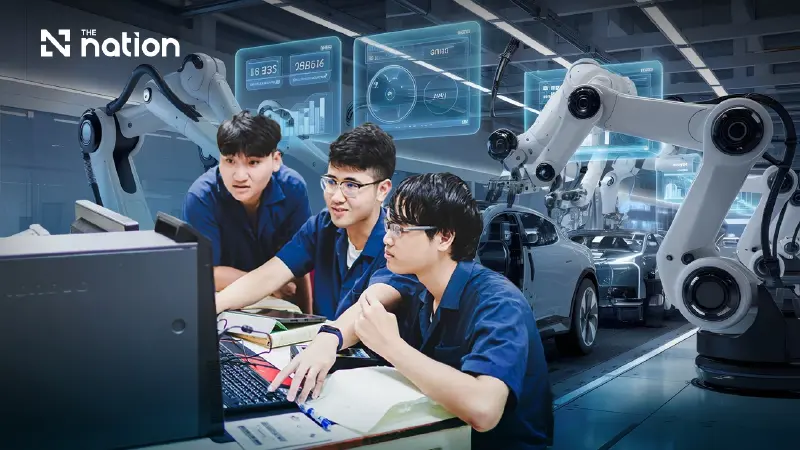


Thailand is turning vocational education into a frontline engine for EVs, AI and advanced manufacturing in the Eastern Economic Corridor.
Thailand’s next industrial leap may not begin in a glass tower, but in a vocational workshop where the tools are changing fast. In the Eastern Economic Corridor, classrooms once associated with engines, wiring and factory maintenance are being redesigned for a new era of electric vehicles, artificial intelligence and smart manufacturing.
This is upskilling with a practical Thai character. As global investors commit billions of baht to data centres, EV supply chains and advanced electronics, Thailand is responding by strengthening the people who will keep these industries moving: frontline technicians, factory supervisors and applied engineers.
The shift is especially visible in the EV sector. Technical colleges are increasingly moving beyond traditional automotive training towards high-voltage battery systems, EV drivetrain diagnostics, robotics and automated assembly. Through dual-education models, students divide their time between classrooms and real industrial environments, learning not only theory but the discipline of working on live production lines.
That matters because the future of mobility will depend as much on skilled technicians as on boardroom strategy. A competitive EV hub needs workers who can test battery modules, maintain robotic systems, read digital diagnostics and adapt quickly as technology evolves. Thailand’s advantage lies in treating this vocational layer not as an afterthought, but as a core part of industrial policy.
At the same time, artificial intelligence is moving from university laboratories into factory floors. Forward-looking institutions are introducing applied AI, computer vision and predictive maintenance into vocational training. The aim is not to turn every student into a research scientist, but to produce graduates who can use AI tools to solve real manufacturing problems: detecting defects, reducing downtime, improving energy use and making production smarter.
Train-the-trainer programmes are also becoming crucial. By equipping instructors with modern digital skills, Thailand can multiply the impact across classrooms and campuses, ensuring that knowledge does not remain locked inside specialist centres.
This approach fits neatly with the country’s National AI Strategy and its wider ambition to build a digitally capable workforce. It also complements the Eastern Economic Corridor’s role as a testing ground for advanced industry, where foreign partnerships, local talent and government support are increasingly being brought into the same ecosystem.
The bigger story is confidence. Thailand is not waiting for the EV and AI future to arrive from elsewhere. It is building the skills to operate, maintain and improve that future at home.
By placing vocational talent at the centre of Industry 4.0, Thailand is showing that the green and digital economy will not be won only by those who invent the technology, but by those who can make it work every day.
