
From software buyers to builders: The AI value proposition for Thai business owners
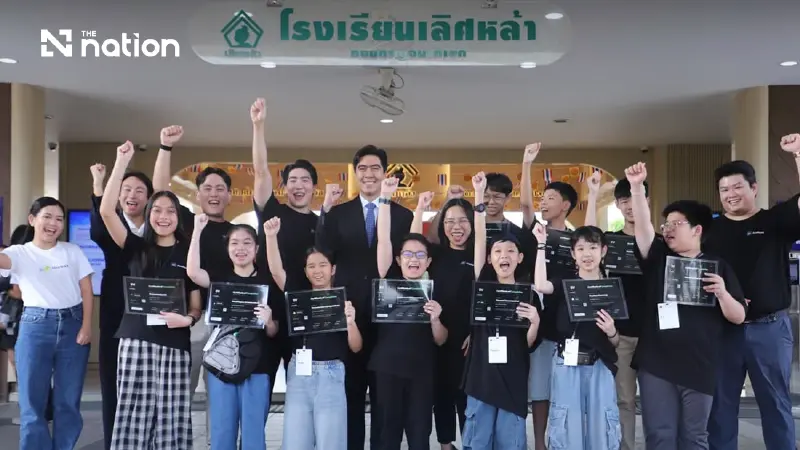


SV Academy, founded by an educator and two Thai engineers who previously developed systems at Amazon, Meta, Google-X, and Databricks, will launch its first course for entrepreneurs and business owners in September 2026. The academy argues that AI has finally brought custom software development within reach for firms that have traditionally relied on outsourcing.
Consider a bubble tea shop owner who envisions a custom point-of-sale system that automatically prints labels with specific sweetness levels, tracks inventory, and predicts future demand. Until recently, achieving this required commissioning external software engineers at a cost reaching millions of baht, or settling for the limited functionality of off-the-shelf software.
The new proposition for Thai small and medium-sized businesses is simple: the owner should become the builder.
This philosophy drives SV Academy, or Silicon Valley Academy, which debuts its inaugural programme for entrepreneurs in September 2026. Its founders contend that artificial intelligence has reduced the cost and time of custom software development so significantly that companies without dedicated programming staff can now own the systems they currently rent.

SV Academy was co-founded by educator Prom Parndejpong alongside two engineers with extensive careers at global technology firms: Krairat “March” Mairin, a former senior software engineer at Amazon and Databricks, and Charlie Pisuraj, a technical infrastructure specialist formerly of Meta, Google, and Robinhood Markets. Collectively, the engineers have managed back-end systems serving hundreds of millions of users.

Shifting from buyer to builder, Thai companies have spent a decade purchasing packaged accounting, warehouse, and CRM software, only to discover these tools cannot adapt to their specific business processes. The founders argue that this technological constraint has now shifted.
“An organisation that can build its own workflow will move faster than one using the same off-the-shelf software as everyone else,” Charlie said.
Their central case is that competitive advantage no longer stems from being the first to acquire technology, but from the ability to customize it to specific business needs faster than rivals.

Proof of concept in the classroom The academy validated its method with children before introducing it to executives. In a pilot program at Lertlah School under the name Silicon Valley Junior, students aged 10 to 15 with no prior coding experience were given five weeks, roughly 12 to 15 classroom hours, to apply Lean Startup methods and AI tools.
The results were tangible: students shipped functional minimum viable products (MVPs), including an application that analyses personal colour palettes and a platform providing educational guidance.
“The heart of software is not the code. It is the way you think, the process, and the mindset for managing AI properly, rather than just firing off prompts,” said Prom. “If we can break engineering-level thinking down far enough for an 11-year-old to build an application, there is no reason business owners cannot do the same.”

The economics, in the founders' numbers, “In the past, a large startup project in Silicon Valley might take close to a year and more than 20 people,” March said. “Now we can use AI, through coding assistants and natural language prompts, to drive the entire coding structure from beginning to end and finish in about two months.”
The academy estimates this approach can compress time-to-market by up to five times. This figure is based on the founders' professional practice rather than independent research.
“Before, if you had an idea for a piece of software, you had to reckon with the very high cost of hiring a development team,” March said. “Now, the cost of actually doing it has fallen enormously. AI is like a personal assistant that costs a few hundred baht a month, so you can keep testing new ideas until you find the one that works and genuinely pays.”

The founders outline three primary advantages for business owners: accelerated market entry with the flexibility to pivot without heavy sunk costs, full ownership of proprietary systems, and the automation of repetitive tasks.
The evolving role of human expertise Neither engineer suggests that professional expertise is becoming obsolete; rather, they argue that its focus is shifting.
“AI is like an assistant that works very fast, but what still needs people is setting the goal, designing the system and making the decisions,” Charlie said. “In the end, how much value the technology creates depends on how we design it to work.”
Prom adds that the curriculum also encompasses branding, product design, and long-term maintainability, ensuring that built systems remain operational rather than becoming abandoned code.

Course details SV Academy for Entrepreneurs and Business Owners is designed for owners without a programming background. The curriculum is structured around each participant’s specific business challenges rather than abstract theory. Participants are expected to build production-ready systems themselves, spanning inventory management, automated ordering, accounting, and workflow automation.
Positioning itself as an incubator and community rather than a traditional training vendor, the academy provides a process blueprint and a mentor network of international specialists, including PhD-level experts from Carnegie Mellon, who provide ongoing support after the course concludes.
The first class begins on September 2026. Details are at sv-academy.org/entrepreneurs.

SV ACADEMY AT A GLANCE
- Founded by: Prom Parndejpong, educator; Krairat Mairin (March), former senior software engineer at Amazon and Databricks; Charlie Pisuraj, technical infrastructure, formerly at Meta, Google and Robinhood Markets
- First programme: Silicon Valley Junior, piloted with Lertlah School, ages 10 to 15, no coding background, five weeks and about 12 to 15 classroom hours
- Result: working MVP apps including a personal colour analysis app and an education guidance platform
- New course: SV Academy for Entrepreneurs and Business Owners, first class September 2026
- Headline claim: up to five times faster to market, the academy's own figure from the founders' practice
- More: sv-academy.org/entrepreneurs
