
Cultivation in Yunnan paves the way for 'durian freedom'
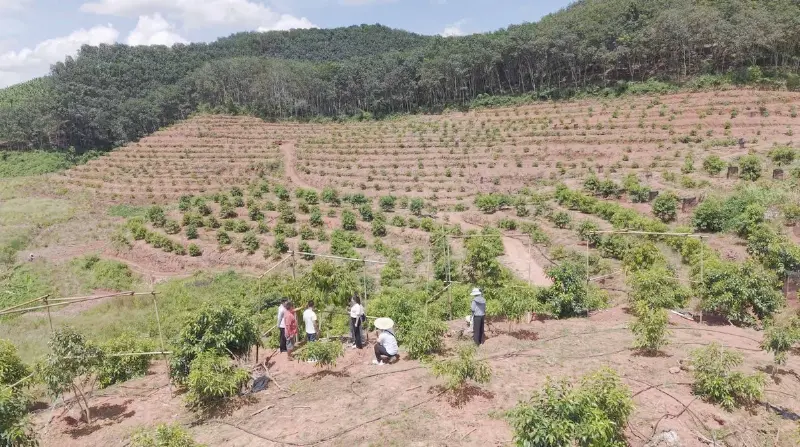


The durian, known as the "king of tropical fruits" and native to Southeast Asia, has been successfully trialled in Yunnan province, raising hopes that Chinese consumers may enjoy more locally-grown durians, according to Yunnan.cn, a local news outlet.
Recently, several villagers in Jinghong city and Mengla county in Xishuangbanna Dai autonomous prefecture shared videos of their ripened durians. Jia Guohua, a farmer in Mengla, said his tree produced 16 fruits this year, a surprising result from a durian seed he had discarded a decade ago.
As a major consumer of durians, China has long relied on imports from countries like Thailand and Vietnam to meet market demand.

Since 2023, Mengla County has introduced several high-quality durian varieties, including Monthong, Black Thorn, and Musang King, covering a planting area of 66.67 hectares. Early trials show a high survival rate and strong growth, with some trees already flowering and bearing fruit.
Current growth observations indicate that the durian plants have a high survival rate and are growing robustly, with some early-planted trees already beginning to flower and bear fruit.

Durian is a typical tropical crop that flourishes in warm, humid environments, with an optimal growth temperature usually between 25 and 30 degrees Celsius, and it also has stringent requirements for water, soil, and sunlight. Yunnan shares an ecological environment similar to northern Thailand and Vietnam, giving it a natural edge in tropical fruit cultivation, according to the report.
The province's "durian map" is steadily expanding. In Jinping County of Honghe, a 3.3-hectare nursery is cultivating dozens of durian varieties from China and abroad, covering different ripening periods and flavour profiles. Meanwhile, Lincang city and Dehong Dai and Jingpo autonomous prefecture have also begun experimental planting.

Experts say that while commercial production is still some way off, Yunnan's progress marks an encouraging step toward what locals jokingly call "durian freedom", the dream of enjoying the fruit freely, without worrying about its price or scarcity, according to Yunnan.cn.

Li Yingqing
Yan Yujie
China Daily
Asia News Network
