
CPF helps give work skills to blind kids
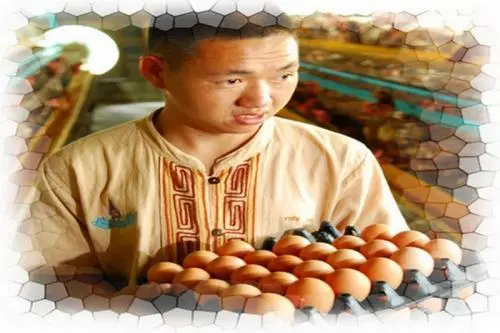


Being blind does not mean that people lack the ability to support themselves financially. That is the understanding of Charoen Pokphand Foods (CPF) and the Rural Lives Development Foundation, and the basis for a project under which blind people are being
A pilot training project is being conducted by the Occupation Training Centre for the Blind in Chiang Mai, part of the Northern School for the Blind (NSB), under the patronage of Her Majesty the Queen (NSB). Blind children are being trained on-the-job to raise laying hens.
“Earlier, the centre provided occupational-training programmes in several branches of agriculture, including pig and fish farming, vegetable cropping and orchard plantations, but the production and earnings from these occupations were unstable. Therefore, Charoen Pokphand Foods and the foundation gave their support by creating a pilot project on hen farming," said the head of the Vocational Training Centre for the Blind in Chiang Mai, Praphan Thongpan.
The school, in Chiang Mai’s San Sai district, was established in 1997, enrolling blind students who were unable to attend normal classes because of multiple disabilities and being too old for enrolment. These students receive vocational-skills training and non-formal education so they can work to earn their living.
The laying-hen project was launched in 2007. The school was provided with a standard and fully equipped chicken house, a first flock of breeding poultry and animal feed, as well as knowledge on chicken raising, marketing and accounting. The number of hens has increased from 250 in the first generation to 350 in the second, 400 in the third and 460 in the present fourth generation.
"The hens provide eggs as food for all the students who live at the school, and the surplus is sold to nearby communities, making an accumulated income of Bt300,000,” Prapan said.
CPF’s assistant vice president Kasem Wilaiprasong said that throughout four years of work, the blind students proved they could do the job. Production of eggs at the pilot project is about 85 to 90 per cent of CPF’s standard. The children work in teams. The working responsibility is clearly divided and working shifts are assigned. The results are highly appreciated, he said.
The team responsible for raising the hens comprises five young blind men, Wallop Poomyim, R-soe Mayoeh, Lah Pang-in, Ekachai Khunthong and Yodrak Sarnmano. They feed the hens by listening to a talking clock. Before they enter the chicken house, they wash their feet in disinfectant water to safeguard the hens against infections. They clean water dispensers with damp fabric, and inspect the feed boxes by touch before filling them with fresh feed, using a measuring cup designed by their teacher. Their speed at picking up eggs is probably faster than people with normal eyesight – as long as nothing blocks the access lane as they progress down the chicken house. They pick up an average of 200 eggs per day.
The eggs are sorted according to weight by a teacher. Some of them are used for the students’ meals, others are sold at a community market or to a local hospital.
The five blind students are given “dividend money” for their work, calculated by their teacher. Above all, they are proud of their duties at the hen farm because they have gained experience and knowledge and learned a practical form of work. When they began the job and realised they could do it as well as people with normal eyesight, they were very happy.
Their good fortune is obvious when it is realised that the lucky students are just five out of Thailand’s 1.3 million blind people.
The training for blind students is part of CPF's “Egg-Giving Chicken Breeding for Student Lunch Project”. Similar egg-producing units have been launched in numerous schools since 1989 to enable young people to produce eggs under their own production-management plan with advice from CPF and the foundation. The eggs are used for school lunches. At present, the project helps to solve a malnutrition problem affecting 75,000 children at 370 schools around the country.
