
New finance minister has great power but also great challenges
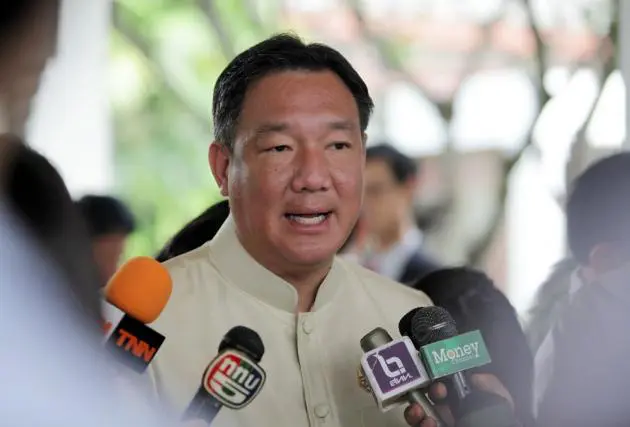


Thirachai Phuvanatnaranubala was finance minister for only five months, but he left behind a good record, while his newly appointed replacement Kittiratt Na-Ranong will face many challenges.
Kittiratt is the first finance minister since the 1997 financial crisis who is also leader of the government’s economic team, as he is also deputy prime minister supervising economic policies. This will give him great power to push forward the government agenda, since he no longer has to face objections from a powerful finance minister who oversees government revenue and tax policy.
“We often see a conflict between finance ministers and deputy prime ministers, for example former finance minister Tarrin Nimmanahaenminda and former deputy prime minister Supachai Panitchpakdi,” said one senior official at the Finance Ministry, noting that those two had different ideas on how to bail out the country in the aftermath of 1997.
Kittiratt and Thirachai also did not get along well. Thirachai was concerned about fiscal and monetary discipline while Kittiratt wanted to spend as much as possible on what he claimed to be necessary government projects.
Thirachai was praised by many economists when he fought against what they saw as extreme approaches proposed by Kittiratt and Virabongsa Ramangkura, chairman of the government’s Strategic Committee for Reconstruction and Future Development. Kittiratt and Virabongsa wanted to intervene in the operation of the central bank to get quick cash.
At least Thirachai managed to remove a controversial clause from the emergency decree requiring the central bank to pay off debt worth Bt1.14 trillion left over from the 1997 crisis and owed by the Financial Institutions Development Fund (FIDF). But he was punished by Prime Minister Yingluck Shinawatra with removal from the Cabinet post.
“Thirachai has more experience and knowledge of fiscal and monetary matters, while Kittiratt, judging from his speech, misunderstands some of these issues,” said Somchai Jitsuchon, research director at the Thailand Development Research Institute (TDRI).
Kittiratt says his priority is to implement four emergency decrees: to deal with the FIDF debt, to establish a Bt350-billion fund to finance post-flood reconstruction, to set up an insurance fund of Bt50 billion, and to oblige the central bank to provide soft loans of Bt300 billion to flood victims.
Former finance minister Korn Chatikavanij and other observers have questioned the government moves, saying that pressing the Bank of Thailand to print money would lead to high inflation and damage investor confidence.
Some observers believe that Kittiratt and Virabongsa indeed want the BOT to weaken the baht by printing more money, as a weaker Thai currency would boost exports. However, there is also the danger that investors could lose confidence over risky fiscal and monetary policies.
Kittiratt may also face difficulty getting cooperation from commercial banks, as they are not willing to pay higher premiums to the Deposit Protection Agency to help finance payment of the FIDF debt.
Supavud Saicheua, managing director of Phatra Securities, said DPA premiums should be used to protect banks’ depositors, not for debt payment. However, Supavud agreed that the banks should make some contribution. “Part of banks’ profits could be used to repay FIDF debt because they have benefited from the recovery of the financial system.”
Virabongsa has said the government should not raise taxes, and Kittiratt is likely to agree with him. Kittiratt said the government would continue to run a deficit for the fiscal year 2013 starting in October.
The two men now are looking for new revenue, or at least trying to reduce public debt by selling government stakes in state enterprises, such as 2 per cent of PTT. They also want to sell government stakes in Thai Airways International.
There are both supporters and opponents of this idea. Thirachai warns against any government attempt to hide public debts by doctoring accounts. But Deunden Nikomborirak, an economist at the TDRI, said she agreed with selling the PTT stake.
“If the government does so, PTT would come under competition law, and consumers could file lawsuits against its monopoly power or unfair treatment,” she said.
She also supported selling shares in THAI because that would allow the airline to do business more efficiently. Under the state enterprise law, THAI is restrained by red tape, she said.
The overall situation might favour Kittiratt as there is consensus that the country needs to make large investments in flood prevention and other infrastructure projects. Many independent economists and those of the BOT have pointed out that the country has invested very little since the crisis of 1997. Meanwhile, public debt is at 40 per cent of gross domestic product, a relatively low level by international standards. “But debt could rise quickly given large investment projects in the pipeline and many populist schemes,” Somchai warned.
Indeed, Kittiratt faces challenges on how to finance these and how to implement them effectively and transparently.
