
Spectra return period may be adjusted
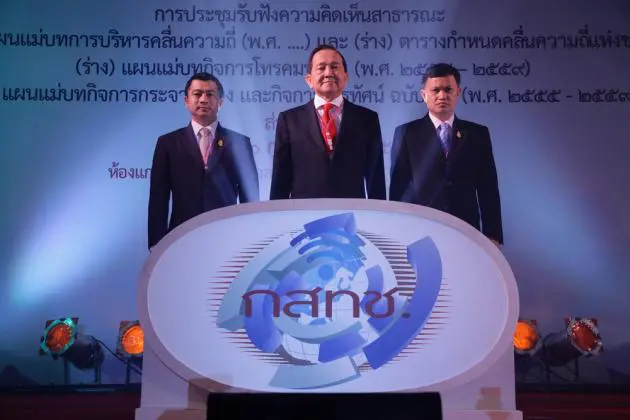


The National Broadcasting and Telecommunications Commission might revise the periods when state spectrum holders will have to return their spectra for reallocation.
NBTC telecom committee chairman Settapong Malisuwan made the remark yesterday at the watchdog’s nationwide public hearing on the drafts of the spectrum-management master plan, the 2012-16 telecom master plan and the 2012-16 broadcasting master plan.
The issue of when the spectra must be returned was one the critical issues in the hearing. While the public sector wants to see the commission take back the spectra for reallocation as soon as possible, the state agencies want more time to adjust their operations in the NBTC era.
As part of the draft spectrum plan, the state agencies have to return concessioned spectra for reallocation once those contracts expire. In the cases of spectra without an expiry date, radio spectra must be returned to NBTC within five years, TV spectra within 10 years, and telecom spectra within 15 years.
The watchdog will also consider the state agencies’ reasons for wishing to retain their spectra and can ask them to return the spectra before the time frame expires, according to the spectrum plan draft.
Prapat Rathlertkan, Electrical and Electronics Industry Club president, said that once third-generation telecom and digital-TV services get off the ground, the value of related local industries such as equipment would grow by Bt100 billion. He wants the NBTC to support research and development in local industry related to 3G and digital TV to boost the local manufacturing business.
Telecoms and consumers yesterday also urged the NBTC to announce a measure as soon as possible to prevent any possible impact on consumers from the telecom concessions as their expiry dates approach.
Settapong said the NBTC would complete an action plan this year to deal with this issue.
The concession terms of Digital Phone Co (DPC) and TrueMove will end in September 2013. Both provide service on the 1,800-megahertz spectrum. A representative of Total Access Communication (DTAC) said the watchdog should finish as soon as possible the spectrum-auction road map to enable cellular operators to prepare their business plans.
Meanwhile, broadcasters want more support from the commission.
Pramote Chokesirikulchai, president for Thai Digital Entertainment Content Federation, suggested that before media liberalisation, the NBTC should focus on the readiness of media enterprises by training in the aspects of professionalism, content and production quality because the spectrum-management and broadcasting master plans would drastically change the landscape of the Thai television industry. Up to 100 digital-TV channels could be available for public viewing in the near future.
Niphon Naksompop, chairman of the Satellite Television Association (Thailand), suggested that the commission should make clear the difference between community radio and community service radio before granting a licence to any operator.
Representatives from commercial community-radio operators said they would not be able to afford the NBTC licences. They suggested the commission grant them licences on an annual-fee basis.
The NBTC is expected to implement the three master plans next month. Then it will work out the action plans for these three master plans.
NBTC broadcasting committee chairman Natee Sukonrat said that in the next step the watchdog would also work out the digital switch-over plan, aiming to migrate the broadcasting industry from analogue to digital technology within four years.
