
Honda network draws on student power for conservation projects
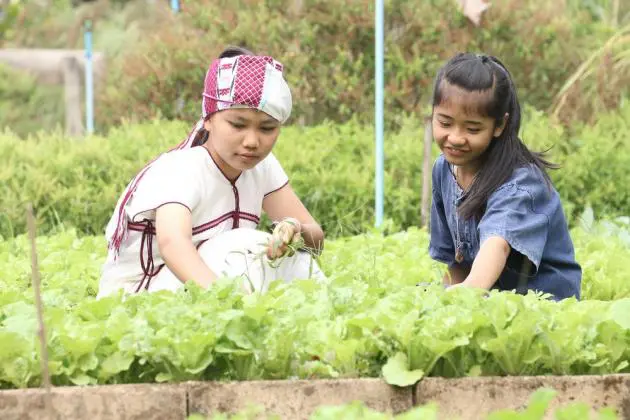


Amid several top-down approaches to handling environmental problems, Asian Honda Motor kicked off a project 12 years ago, inviting schools nationwide to share their ideas on how to save their planet.
Since its inception in 1999, the “Honda School Environmental Challenge” has attracted participation from 765 schools and helped the company build up the Green Schools Network with a number of sustainable environmental conservation projects.
Siriporn Srisuk, social contributions manager of Asian Honda Motor, said the project was launched to celebrate His Majesty the King’s 72nd birthday and to honour the King’s long-term commitment to the environment. Hosted every two years, this year the challenge involves 84 schools, each receiving Bt60,000 financial support. The one producing the most impressive results will win His Majesty’s trophies.
”We have drawn increasing attention each year. After handing out financial support, we will send a team of judges to the schools to give them the points,” Siriporn said.
Honda recently took the media to Sanparai School in Tak (elementary level) and Fangchanupathum School (secondary level) in Chiang Mai, the two winners this year.
Sanparai School impressed the judges with the cooperation between the school and the community in tackling water contamination from farming chemicals. Wastes are segregated, forests are regrown while dykes are built, along with a pond to treat sewage water. Villagers are educated on the watershed and how to handle household water waste.
Teacher Phoungphet Chimsud said that the school joined the Honda Challenge in 2002. About 80 per cent of 136 students are karen, the tribe which was formerly notorious for forest encroachment. She said the community experienced severe drought while garbage was scattered. Due to heavy chemical use, contamination problems were high. With support from the community and related government units, dykes were built to slow water flow and teak trees were planted to rebuild the watershed.
Pathom Mantaham, 16, first joined the project to make disposable pots for teak tree seedlings. The seedlings are sold to villagers at Bt2-Bt6 each, becoming another means to financially support the school. His family and others regularly moved farming areas but they have stopped now, thanks to the school’s campaign.
Supaporn Kamon, 13, joined the school’s project when she was 10. First considering it as a subject, she learnt later that all must take care of the environment, starting from home. She shared her knowledge of organic fertilisers with her father, and after successful results, her father never uses chemicals to get rid of bugs again.
”The school now has 10 techniques to share. I myself am interested in hydroponic plantation. I could build a career on it,” she said.
Joining the challenge in 2008, Fangchanupathum School won the trophy thanks to the integrated farming approach of which environmental conservation is the top priority. With support from all teachers and students, the school allocated a plot of 188-rai for the new farming approach, based on His Majesty’s sufficiency economy philosophy. Of the plot, 30 per cent is reserved for water retention, 30 per cent for rice farming, 30 per cent for fruit plantation and 10 per cent for housing.
Titthinat Saktananont, director of the school, added that through the inclusion of conservation in all subjects, students are also urged to take part in environmental conservation. “We believe that children would be the key drivers in tackling environmental problems,” he said. The effort is not fruitless.
Puripat Khamma, 17, applies the knowledge in his family. In the school, all rooms have their own power meters, and the rooms with the lowest consumption in each month would win prize coupons. Each student is then encouraged to turn off power or warn others who excessively use computer. This has become a habit for Puripat.
”I think we’re lucky to be in Thailand. We have the King whose projects help create jobs for people and tell them how to live with sufficiency and happily,” the student said.
