
Gaggan Anand: Food Is Humanity's Strongest Culture
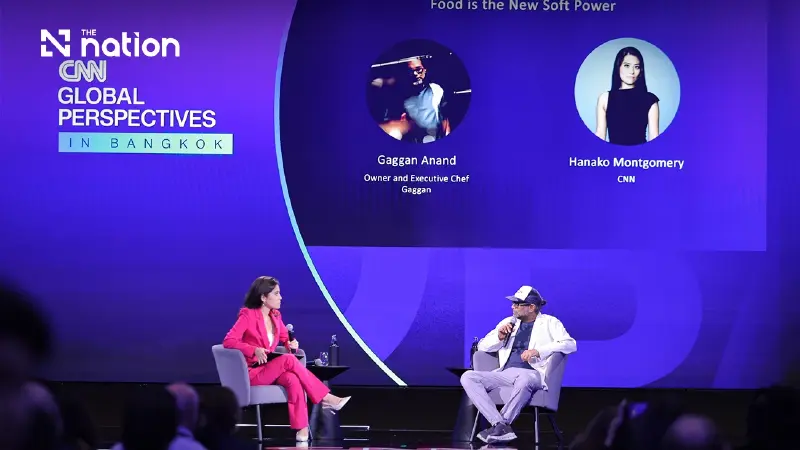


At a CNN panel in Bangkok, the Michelin-starred chef says phone-free dining, memory and surprise are food's real power
- Michelin-starred chef Gaggan Anand argues that food is humanity's strongest culture, suggesting that the act of cooking was the first step in human evolution that separated us from apes.
- He believes food's real power lies in its ability to create memories and surprise, which is why he bans phones in his restaurant to encourage diners to be fully present in the experience.
- Anand sees food as a unifier that also expresses diverse identities, citing how a common ingredient like rice is transformed into distinct cultural dishes such as sushi, biryani, and fried rice across Asia.
At a CNN panel in Bangkok, the Michelin-starred chef says phone-free dining, memory and surprise are food's real power.
When a chef bans phones from his dining room, he is making a statement about more than etiquette. For Gaggan Anand, it is a plea for people to be present, to taste, to feel and to remember.
Speaking at the CNN Global Perspectives Panel Discussion in Bangkok on Wednesday 14 October, the owner and executive chef of Gaggan, the Michelin-starred restaurant in Thailand's capital, delivered a funny, fiercely personal defence of the dining table.
The session, titled "Food is the New Soft Power", explored how cuisine has become one of the most potent ways nations build identity, attract visitors and shape influence far beyond their borders.
Moderator Kristie Lu Stout of CNN opened the session by noting that many in the audience had probably spent their lunch break checking emails and doom scrolling. Anand's restaurant, she said, is built on the opposite principle.
A concert without screens
Anand traced his no-phones policy to a concert in Yokohama, where a favourite band asked the 20,000-strong crowd to put their devices away.
"In this century, for the first time, I saw a concert without a phone in front of me," he said. "I was born in the last century, where we listened to music on a tape and on vinyl, and everything was analogue."
The experience prompted him to rethink what a restaurant is for. The word itself, he reminded the audience, comes from "restoration": a restorative soup offered to weary travellers.
Today, he argued, restaurants have shifted "from being a luxury" to "a necessity" for city dwellers with little time or space to cook.

His answer was to create a place that "bars people from showing off that they're in the restaurant" and instead lets them enjoy "the romance of being in a restaurant".
For Anand, the issue is also one of respect.
Having started cooking 29 years ago, in an era without smartphones, when it was just "fire, a knife and ingredients", he finds it painful to watch guests ignore the dish in front of them.
"I am trying to explain the effort that goes to make a dish when the other person is on the phone, and I feel insulted," he said.
Lu Stout, who dined at the restaurant earlier in the week, admitted the policy felt daunting at first. Once she relaxed into it, she said, it became "one of the best experiences I've had in a really, really long time".
Influence, with caveats
Asked about food influencers, Anand did not hold back at first. "Oh, I hate them all," he joked, before turning the question back on the industry: "What are you influencing? We can't eat on TV. We can't eat on cameras."
He then softened, acknowledging a "thin red line". Social media, he suggested, is like nuclear technology: it can power something sustainable or cause damage.
"You can really create good food. You can create good memories in a restaurant," he said.
The danger, in his view, is a culture in which restaurants thrive because of a viral stunt rather than the quality of the cooking.

Memory on a plate
The chef's cooking philosophy rests on the idea of serving memory. Raised in what he called a "very normal" Asian family where "we used to cook to survive", he recalled his mother turning a potato into mash or a curry.
Travelling from Chile to South Africa, Australia to Japan, he said, taught him one lesson above all: "The only thing I've understood is the culture. And food is the strongest culture we have."
Why? His answer was characteristically playful.
"What is the difference between us and apes? We cook. They don't," he said, adding that cooking "was the first step towards evolution."
He even nominated barbecue as humanity's first dish, to which Lu Stout added that today's tastes run to medium-rare or plant-based alternatives.
The sixth sense: surprise
Anand's cuisine famously keeps diners guessing. He describes a "5S philosophy": sweet, sour, salty, spicy and, finally, surprise. The roots lie in a mischievous childhood.
"I was one of the naughtiest kids in the whole vicinity," he said, admitting he still enjoys a prank. Surprise, he explained, is what gives food emotion.
"We live for thrill, and I try to give you thrill in the food."
Rice, rivalry and a shared Asian table
Though his menu draws on Indian, Japanese and Thai traditions, Anand declined to be cast as a cultural ambassador.
"I don't want to carry the weight of any nationality," he said. "I represent myself, and I represent Asia, because Asian culture is so diverse."
The common thread, he suggested, is rice, which becomes fried rice in one place, sushi in another, biryani in a third and Hainanese-style chicken rice in Thailand.
Even after decades of travelling the continent, he said, "I have still not seen Thailand fully. I've still not seen Japan fully. And I still don't know where India is."
He argued that food history has been neglected. Colonial exchange spread chillies and spices across the world, but much of that story, he said, was never properly documented.
Asked about chicken tikka masala, he compared it with the California roll: both were "accidents", born outside their countries of origin. Lu Stout, for one, confessed a soft spot for both dishes.
Looking ahead, Anand sees Asia's culinary stock rising. Over the last 20 years, he said, chefs in the region have worked to shake off Western labels, and Asia has emerged as "a soft power of food" with ever more layers to explore.
His own country remains a work in progress. "I don't know my country yet," he said, quipping that he still carries an Indian passport and queues for visas.
He reached for a vivid reminder of how value shifts: black pepper, once called "black gold" in the Roman Senate and worth four times the price of gold, is today "cheaper than salt". Understanding that history, he said, is crucial: "Our future is our past."
