
Gold soars on QE3 expectation
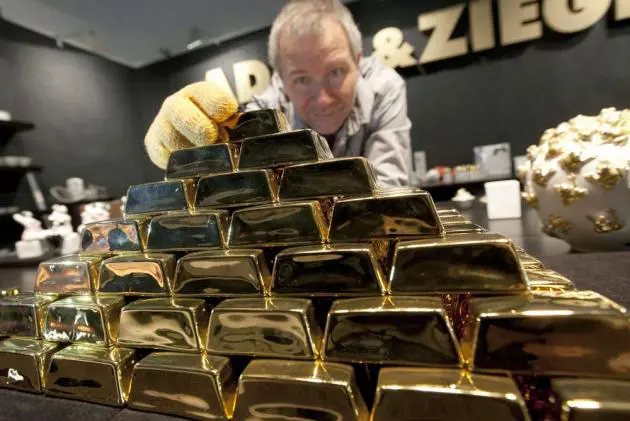


Expectations for a third round of US quantitative easing (QE) and the recent weakness in the US dollar have boosted gold prices.
The precious metal should continue to appreciate, as QE3 may fuel inflation following liquidity injections into the financial market, making gold more attractive as an alternative investment.
It is widely expected that the US Federal Reserve will buy more government-backed mortgage securities after the pace of US job creation slowed, according to Morgan Stanley and JPMorgan Chase.
Bloomberg reported that with Morgan Stanley’s economists and interest-rate strategists now assigning 80-per-cent odds to QE3 from the Fed, its mortgage-bond analysts – including Vipul Jain and Janaki Rao – believe that QE3 may involve about US$200 billion (Bt6.3 trillion) in additional purchases of home-loan debt over nine months, almost doubling the current programme.
Since the Hamburger Crisis of 2008, the Fed has injected nearly $2 trillion into the market, but the US economy remains in a fragile condition. US job growth slowed to 69,000 in May from a high this year of 275,000 in January even as the Federal Open Market Committee sustained record stimulus, including a pledge to keep the benchmark interest rate near zero until at least late 2014.
The US unemployment rate is 8.2 per cent now. QE3 is in line with the US policy to lower the unemployment rate to 7 per cent by 2014 and increase economic growth by 3 percentage points in three years.
Charles Evans, president of the Federal Reserve Bank of Chicago, said recent US economic data warranted "extremely strong accommodation".
The greenback yesterday also weakened against the euro as the Group of 7 industrialised nations pledged their support to help address the euro-zone crisis.
"A weaker dollar would implement stronger gold," Afshin Nabavi, a senior vice president at bullion refiner MKS Finance in Geneva, told Bloomberg. "The safe-haven investor has been very shy since December. If they decide to get back into the market, then there’s potential for a lot of upside."
In London, gold rose to a four-week high yesterday. Bullion for immediate delivery rose as much as 1.3 per cent to $1,637.40 an ounce. August-delivery futures were 1.3 per cent higher at $1,637.40 on the Comex in New York.
In Thailand, the bullion price was raised three times, each by Bt50 per baht weight. At 2.57pm, it was sold at Bt24,700 against the gold spot price of $1,633.50 and dollar/baht exchange rate of 31.46. It is hovering near the record set in November 2011, when the monthly average was as high as Bt25,480, according to the Thai Gold Traders Association’s data.
"Gold analysts across the world foresee a possible hike in gold price to $1,840 late this year," MFC Asset Management said. In a statement, it noted that besides the weak dollar, gold prices could rise on potential long-term inflationary threats, accumulation of gold among central banks, and tight demand and supply.
"More stimulus measures are expected in the US, UK, Europe and Japan, which would only increase liquidity and weaken major currencies like the US dollar," it said. From net gold sellers during 2002-08, central banks have been net buyers to cushion foreign exchange risks.
