
PM's Office Minister mulls legal actions
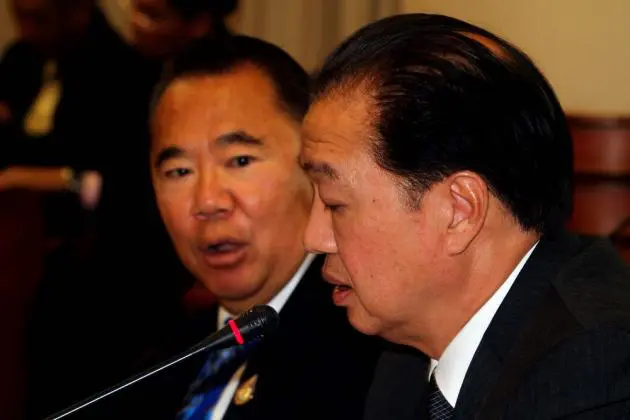


Prime Minister's Office Minister Worawat Ua-apinyakul threatened to take criminal and civil actions against parties which deprived consumers of their rights, concerning the broadcasting of Euro 2012.
All involved parties are summoned for a meeting at the Government House tomorrow at 3pm, which will be participated by the Department of Special Investigation.
"Should we need to take any action (as the issue could not be settled), this will be handled as a special economic case," he told reporters, after the testimonies of all parties involved to the House Committee on Broadcasting and Telecommunications.
Aside from Worawat who oversees the Consumer Protection Board, representatives of National Broadcasting and Telecommunications Commission, TrueVisions, GMM Z - the subsidiary of broadcasting rights holder GMM Grammy, and the satellite TV association were present at the Parliament Building. This session followed Uefa's refusal to GMM's request to "sub-license" the broadcasting rights to TrueVisions, of which network covers 1.8 million households. Uefa cited that TrueVisions should not get the rights as it is a pay TV network.
Though the tournament can be watched mainly through terrestrial analog system (through antennas) and GMM's set-top boxes, GMM Z has insisted that it has done everything under its capacity to pass the signal to all consumers. TrueVisions also noted that it was ready for any suggestions, adding that helping broadcast signal from free TV channels has nothing to do with its status as a pay TV network or not.
During the session, Democrat MP Sirichok Sopha also pressed GMM for the contract with Uefa. The request was denied, as GMM said that such demands Uefa's approval. There was a speculation that both GMM and TrueVisions collaborated in this regard, as GMM's set-top boxes are available in 7-Eleven stores which are operated by a sister company of TrueVisions.
Worawat noted that a number of consumers pressed for actions, saying that the government is ready to inform Uefa in writing how this matter affects Thai consumers.
