
Subsidy policies need rethink, say experts
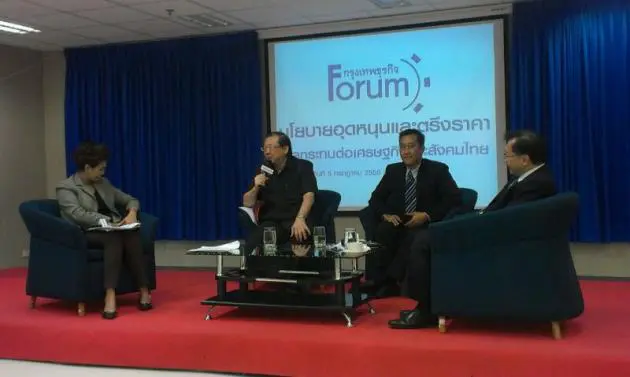


The government should re-prioritise its subsidy policy given the huge social and economic impacts, which could erode the country's long-term competitiveness particularly after the regional integration, a recent seminar heard.
Hosted by Krungthep Turakij newspaper, the seminar on “Subsidies and Their Social and Economic Impacts” focused chiefly on the subsidies for energy prices and agricultural crops.
“Subsidies are still necessary if they fit two main themes: if there is insufficient competition and if they are producing benefits to third parties,” said Praipol Khumsap, a Thammasat University economist and former member of the central bank’s Monetary Policy Committee.
In the first area, applicable are free vaccination and education or products at subsidised prices where few producers exist. Subsidies to promote renewable energy fit the second area, given the need to lower the country’s energy imports as well as help the world reduce carbon emissions.
“In medical, education and industrial fields, there are products and services that still need subsidies. If the subsidies are launched to fit the two main themes, I should say that the government has good reasons to back up their need,” he told the audience.
He said, however, that the current energy subsidies should be abolished, as they encourage wasteful consumption, leading to high energy imports and carbon-dioxide emission.
It was the previous government of Abhisit Vejjajiva that promised to keep the retail diesel price below Bt30 per litre, but Praipol said the current administration had no reason to continue the policy. The government should also end two-decades-long subsidies on liquefied petroleum gas (LPG) in light of misuse of the product and widening burden of the Oil Fund. He said the Oil Fund should divert its finances to promote ethanol, offer LPG subsidies only to the poor, and stabilise energy prices in very volatile conditions.
Though it is a net energy importer, Thailand’s LPG price is now the lowest in Asean, he pointed out.
He agreed that it was easier to deal with energy subsidies than those for the agricultural sector, which involves a large number of farmers.
On this front, Aat Pisanwanich, director of the Centre for International Trade Studies at the University of the Thai Chamber of Commerce, attacked the government of Prime Minister Yingluck Shinawatra for vying for votes by launching subsidy programmes for nearly all types of crops.
Aat suggested a price-guarantee scheme for rice rather than the pledging scheme being implemented now, to ensure direct benefits to farmers and limit distortions that hurt the export sector and Thailand’s position in international rice market. The pledging scheme, which now covers tapioca and rubber as well as rice, could result in unpredictable costs to the government.
In an interview to The Nation, Ammar Siamwalla of the Thailand Development Research Institute estimated that the rice-pledging scheme would cost the government more than Bt70 billion this year, with off-balance-sheet spending of Bt300 billion.
“Farmers are inclined to expect an increase in prices in the years to come, unaware of any risks. With this in mind, they have zero understanding of competition. This is worrisome, as the agricultural industry, like others, is heading to full liberalisation under the Asean Economic Community,” Ammar said.
With financing from foreign investors, Cambodia now produces Nian Mali, a direct competitor to Thailand’s jasmine rice. Vietnam is taking over Thailand’s position as the world’s largest rice exporter, with huge output of white rice. And with cheap land rents of Bt10 per rai (Bt62.50 per hectare) per month, foreign investors are flocking to Myanmar for rice, rubber and palm plantation.
Rather than shoring up crop prices, he suggested that the government channel money into production costs and yields as well as promoting the value chain of agricultural products. The Malaysian government now limits rubber plantation, depending on supplies from Thailand, but it promotes the production of rubber gloves and other products that produce higher margins, he said.
Meanwhile, the Malaysian government also puts money into research and development to find the best seeds and extends help on fertilisers and pesticides.
“We can’t afford blanket subsidies with limited resources. Certainly, as food prices tend to rise in the future, subsidies are necessary in some areas, but we have to let go of these in other areas. The available funds should be diverted to help [farmers] in the areas of marketing and innovation,” he said.
“Subsidies are distorting the picture. Politicians should ask, if they are good, why do farmers remain poor after two decades of intervention? When the AEC is activated, how will these farmers thrive?” he asked.
Montree Socatiyanurak, director of the National Institute Develop-ment Administration, said politicians were turning a blind eye to these facts. Given their short periods in office, they tend to come up with short-term policies to win votes, rather than laying out long-term policies for long-term competitiveness.
“The market mechanism should be allowed to take full control, and the government should limit its role to ensuring a level playing field and sufficient subsidies to the very needy. Some still need subsidies,” he said.
