
Sorajak out to pilot THAI back in black
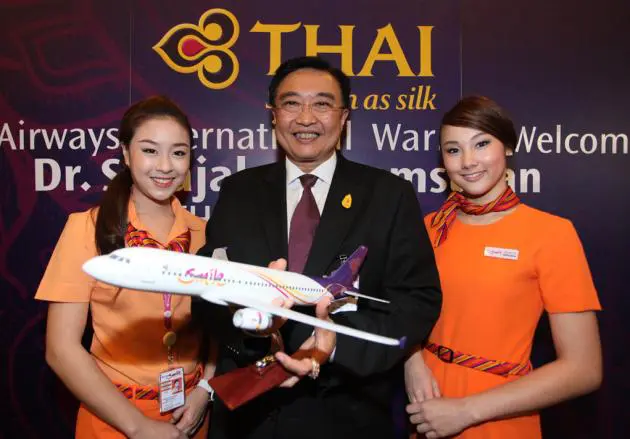


Sorajak Kasemsuvan, who yesterday took the helm as president of Thai Airways International, pledged to do his utmost to maximise the ailing airline's growth potential in both sales revenue and |earnings.
He signed an agreement on Monday afternoon to head the national carrier at a monthly salary of Bt800,000 until February 2015. The figure, which he chose not to negotiate over, is less than that earned by the previous president.
Yesterday, there was an army of print and broadcast media representatives eager to fire questions at him on his first public appearance as THAI chief.
He told reporters that he did not feel any concern about taking up the post, even though he would face external and internal pressures, especially in regard to returning the company back to profitability after last year’s loss of Bt10.2 |billion.
He accepted that the airline, which is a state enterprise, could not avoid “political involvement” because representatives from a number of ministries are in charge of its operations. Sorajak said fuel prices posed a high risk for the business, as fuel accounts for 40 per cent of THAI’s overall costs. He will have to carefully consider oil-price hedging to save on operating costs, he added.
“It’s too early to reveal THAI’s business direction now,’’ he said, adding that his vision for the carrier would become clearer after proposing the business plan to the board by December 31. His first official meeting with the board is on Friday.
IMMEDIATE PRIORITIES
The airline chief said he would put a major effort into THAI making a profit in the final quarter of this year.
One of the first priorities is to maximise its route network, especially via an increase in flight frequency. China, India, Russia and Japan offer good potential for achieving this, as the markets are not in a state of oversupply, he said.
Even with the rising number of low-cost carriers, Asean and other Asian markets still offer bright business opportunities, he said, adding that THAI has a competitive advantage over its rivals, especially when it comes to its good aviation time slots.
Online ticketing is another focus area for the new president, as it offers the option of greater price flexibility. THAI still earns marginal sales from this channel, while rivals have been able to generate sales of 15-20 per cent from this market.
“If THAI can get sales of 10 per cent from the online channel, I will be very happy,” he said.
Another focus area is to differentiate the airline from its rivals. He said he would create a “Thailand branding” initiative to promote THAI’s innovative service as a way to increase sales.
For example, the carrier will be promoted as “the best Thai restaurant in the sky”. Otop (One Tambon One Product) items with good potential will also be on sale on-board.
However, Sorajak said he knew it would be tough running such a large company, especially when it came to achieving employee harmony.
He accepted it was common for an organisation with 25,000 people to have some problems, but said he would do his best by treating everybody fairly and |seeking to secure their future with the company.
