
3G auction: NBTC 'happy' regardless
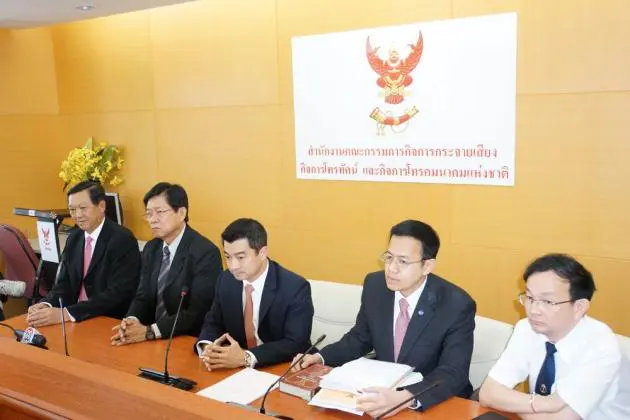


Despite possible low competition among the three bidders for 3G-2.1GHz licences, the telecom regulator insisted yesterday that it would be satisfied with whatever the outcome of its auction was next week.
The National Broadcasting and Telecommunications Commission (NBTC) faces its first legal challenge to the auction today when telecom activist Anupap Tiralap petitions the Administrative Court for a temporary injunction against the auction.
He will cite the lack of quality standards for third-generation wireless broadband service, of a cap on 3G data-service fees, of a guarantee of equal 3G access for all Thais, and of an explanation of how the proceeds from the auction will be used to benefit the public. The legal move is aimed at protecting consumer rights, he said.
The telecom committee has qualified all three applicants – Advanced Wireless Network, a unit of Advanced Info Service (AIS); DTAC Network, a subsidiary of Total Access Communication; and Real Future, part of True Corp.
Settapong Malisuwan, chairman of the NBTC telecom committee, believes the auction will see competition, despite having only three |bidders.
“Price is not the issue. The final price could be higher than the reserve price of Bt4.5 billion, depending on the bidding competition. If the final price ends up at Bt4.5 billion, it’s all right. While some say the reserve price is too low, others say it’s too high. It’s impossible to please all 65 million people,” he said.
The NBTC would stop the auction if collusion were found among the bidders during the auction, he said.
If the auction does not proceed according to law, it could be cancelled. If it’s cancelled because of legal challenges by any parties and is later found to be legal, the NBTC will exercise its right to counter-sue those who caused the auction to be called off.
The auction terms and conditions have drawn criticism for allowing the three bidders to grab the spectrum slots amid low competition. When asked by media whether the NBTC will refer to the reservation clause in the auction terms to change the rules if it ends up with a low price, NBTC member Sukit Khamasundara said the term “necessary” in this clause referred to such situations as fire and flooding.
The reservation clause says the NBTC can change the auction rules, or even suspend or cancel the auction, if necessary.
NBTC member Suthiphon Tha-veechaiyagarn said that if the watchdog made any abrupt change in the auction regulations, it would risk a lawsuit from the bidders.
The NBTC will on October 16 next Tuesday call for bids for nine slots of the 2.1-gigahertz spectrum, each containing 5 megahertz of bandwidth, at a reserve price of Bt4.5 billion each. Each of the bidders can go for a maximum of three slots. The Bt4.5-billion reserve price is based on 70 per cent of the full value of a 5MHz slot, which has been calculated at Bt6.4 billion.
Somkiat Tangkitvanich, president of the Thailand Development Research Institute, said recently that the auction should go ahead, or the Kingdom would lag further behind other countries in making third-generation cellular service available.
However, he questioned how the NBTC would show accountability if the auction did indeed experience low competition, which he estimated could cost the state coffers some Bt17 billion.
The NBTC will pass the auction proceeds to the state coffers. As part of the tender’s terms and conditions, the winners of 10MHz bandwidth or more must provide network coverage to 50 per cent of the population within two years, and to 80 per cent within four years.
They could be fined for failing to meet these network coverage standards. Their network capacity for data transmission must also satisfy the NBTC’s mobile data service standard regulations.
Settapong said that as far as he knew, the three bidders were expected to get their 3G networks up and running in major cities within three or four months of obtaining the licences.
The watchdog is expected to grant the licences in January. It will monitor the licensees’ service quality and service fees, which must reflect their costs throughout the 15-year licence term.
