
Construction: The debate rages on


Experts mull challenge of taming Asia's boom with 'green' development
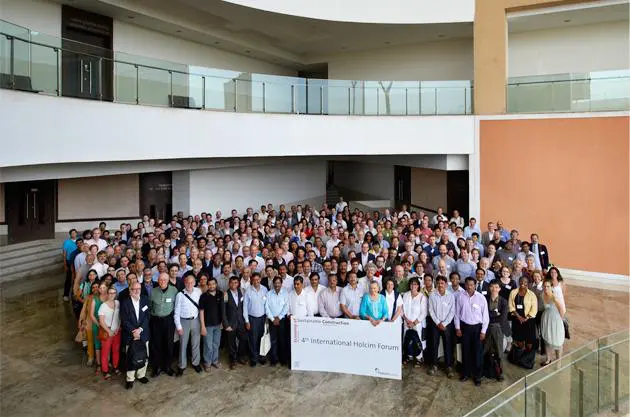
Sufficiency economy” was a repeated phrase at the 4th International Holcim Forum,as efforts continue at the global level to seek a new paradigm for sustainable development.The idea of economic sufficiency has been developed by the Thai King, but rather than a Thai participant it was German-born Werner Sobek of Stuttgart University who raised the new concept for ethical development.He cited the example of India,where large numbers of young citizens want the improved services and facilities of a modern lifestyle. Yet,because of the sheer numbers involved, youngsters could not expect each to live in their own spacious home. “It’s no longer a financial question but an ethical concept that is needed for a solution, said the academic.Sobek took part in a closing-session debate for the three-day Holcim Forum, attended by 300 experts from all over the world and hosted by the Indian Institute of Technology Bombay. The theme was the “Economy of Sustainable Construction”. The conference explored the paradigm shift emerging from the growing awareness of the economic potential of sustainable
development. In his keynote address earlier, Lucas Bretschger, Professor of Economics at the Swiss Federal Institute of Technology, summed up the economics of sustainable construction thus:
structure. Domestic consumption of materials in Asia increased from 6.2 billion tonnes to 37.5 billion tonnes between 1970 and 2008, an annual growth rate of 4.8 per cent. China and India have considerably upped their consumption,with China accounting for more than 60 per cent of the region’s total domestic material consumption, and India more than 14 per cent. The regional average per-capita material consumption now stands at 89 per centof that of the rest of the world. The report found that the region is moving from a biomass-based to a minerals-based economy. The most populous countries such as China and India are transitioning from agrarian to industrialised economies. Thailand is falling into the same condition. Biomass dropped from more than half, to 25 per cent of the region’s domestic extraction, while construction materials grew to 51.4 per cent. The findings of the report conclude that countries in Asia and the Pacific face even greater challenges to make the transition of current economic growth patterns towards ‘green’ growth, and to transform the economies into truly ‘green’ economies,” Park said. In the final-session debate at the Holcim Forum, Marc Angelil of the Swiss Federal Institute of Technology said that while economic uplift can be widely experienced from recent economic development, such development had impacted the ecological footprint. Ashok Lall, a well-known Indian architect, said the built environment was shaped by “economics and power”, and without better understanding of it “the transition towards sustainability” can’t be made. The magnitude of the challenge was summed up by Nimal Kishnani from the National University of Singapore, who estimated that Asia’s urban centres are attracting 20,000 newcomers each day, an influx which the “market and government” is unable to address. “Architects,” he added, “must act as agents of change.” Moderator Rolf Soiron, chairman of the board of Holcim Foundation for Sustainable Construction, highlighted three agenda which participants at the Forum had yet to sufficiently address:
| Issues addressed at the forum | ||
|
The construction industry can contribute to global |
The overall strategy then was to reduce human consumption. This forum carried the theme “Economy of Sustainable Construction”. The forum took place in mid-April in Mumbai. With roughly 18 million inhabitants, Mumbai is a city of opportunities but also one with deep disparities of wealth and deteriorating environmental conditions. The forum was hosted at the Indian Institute of Technology (IIT Mumbai). The Thai participants were Bundit Chulasai and Pattama Roonrakwit from Chulalongkorn University and Singh Intrachooto from Kasetsart University. |
