
Indian PM visit meant to push comprehensive FTA


Play
Signing of 6 MoUs among key issues
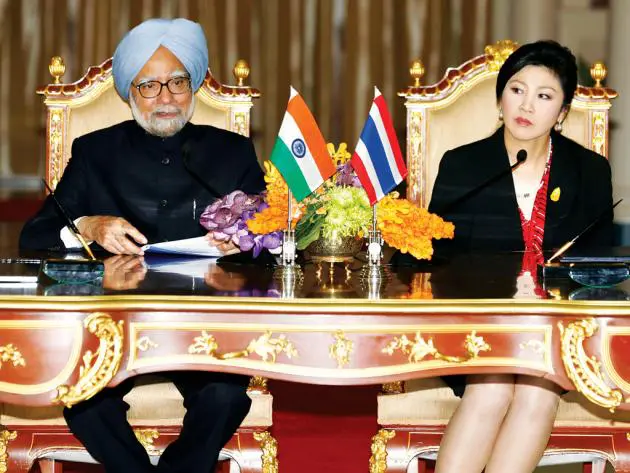
Indian Prime Minister Manmohan Singh visited Bangkok on Thursday, marking his first official visit, during which the comprehensive free trade agreement (FTA) between Thailand and India was on top of his agenda.
India’s ambassador to Thailand, Anil Wadhwa, said: “Prime Minister Singh was here before, in 2004 and 2009, but for Asean and related events. Last year, Thai Prime Minister Yingluck Shinawatra visited India as the chief guest of our Republic Day in January and later the same year visited India as part of the Asean-India commemorative Summit. So this is the return visit.
“Both prime ministers have large agendas, and they were to sign six MoUs [memoranda of understanding] during the visit, including extradition, space cooperation for urban satellite mapping, and mapping of Buddhist sites in Southeast Asia.
“Another MoU is to set up a chair for Indian studies at Thammasat University.
“We will also work together on anti-money-laundering efforts and promote bilateral exchange programmes of academics, journalists, and other people-to-people contacts.
“Prime Minister Singh will also call for the acceleration of negotiations to conclude the bilateral FTA between Thailand and India, as the two countries’ negotiators have already held 26 rounds of negotiations, with the last one taking place in New Delhi last November.
“The comprehensive FTA covers goods, services and investment as well as issues of technical barriers to trade and investment, sanitary and related items.
“We have nearly concluded negotiations on the reduction of import tariffs, with each country expecting to add 60 tariff lines to the FTA, bringing the total to 120, plus the existing 84 tariff lines under the current FTA.
“On investment, we don’t need to negotiate much, since we already signed the Asean-India FTA covering investment.
“We can borrow the provisions from there. On the services sector, both countries have strong interests here, as we require more liberalisation and freer flow of professional workers who can go to work in each other’s country.
“For example, from Thailand it will be the spa trainers, and others in the services industry, restaurants, the chefs etc.
From India it’ll be specialists in India’s traditional medicine, dancers, artists, yoga trainers etc.
“This will prepare ourselves well for the Asean Economic Community in 2015, as there will be a freer movement of people in Asean countries.
“We also need to complete the chapters on barriers to trade, sanitary and dispute-settlement mechanisms, as we have exchanged texts on these topics. We hope the prime ministers will tell their respective ministers and negotiators to complete the negotiations as soon as possible and hopefully [before] the end of this year.
“Another important issue is connectivity [among] India, Myanmar and Thailand via the trilateral highway, which will be completed in 2016.
“This will facilitate the movement of people and goods across borders along the 1,600-kilometre highway.
“This will lead to new investment and economic prosperity for many people in the region, linking India’s northeastern state with Myanmar’s northern region, passing Mandalay, Nay Pyi Taw and reaching Thailand’s Mae Sot district in the North.”
“Last year, we held a cross-border car rally to commemorate India-Asean relations using the trilateral highway to reach eight other Asean countries.
It proved that we could travel by car from the northeastern part of India all the way down to Singapore passing Thailand twice.”
