
Major Asean economies buck the downtrend


Play
AGAINST THE downward sentiment across the Asia-Pacific region, major Asean economies - Indonesia, Malaysia, the Philippines, Thailand and Vietnam - continue to outperform thanks to their domestic focus, Standard & Poor's Ratings Services said yesterday.
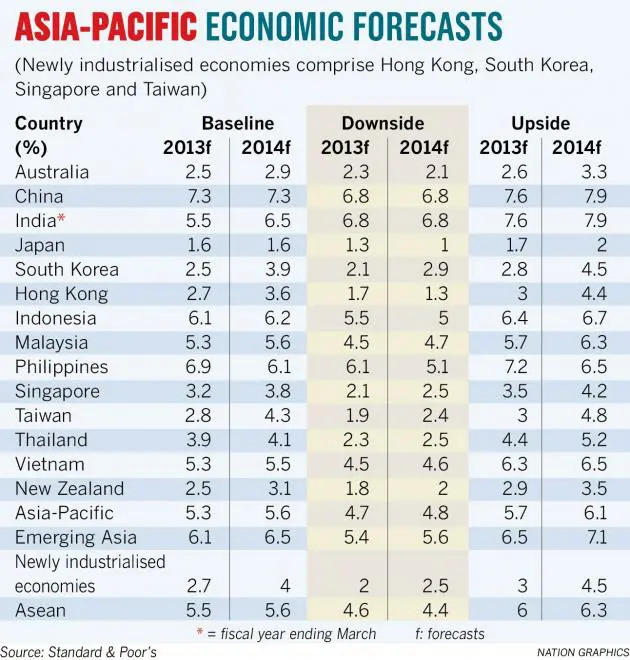
Its report titled “Asia-Pacific’s Growth Continues to Slow along with China but Japan Looks Ready to Blossom” said these economies were more domestically focused than the newly industrialised economies and tended to do better when global growth was sluggish.
“We expect growth for Asean as a whole to remain steady at about 5.5 per cent through 2015 in our baseline scenario. The Philippines, which Standard & Poor’s recently upgraded to investment grade, has taken over the Asean growth leadership role from Indonesia. We project Philippine GDP to expand by almost 7 per cent this year, moderating to 6 per cent and 6.5 per cent in 2014 and 2015,” it said.
Indonesia’s growth momentum remains strong, but financing the resulting current-account deficit has become increasingly difficult. Bank Indonesia raised the policy interest rate by 75 basis points over the past few months to contain inflation expectations after the fuel-subsidy cut. The central bank’s rate increase can also help support the rupiah and ease domestic demand to improve the current-account deficit.
Thailand lags in this group as it is relatively more trade-dependent. Malaysia is also relatively open, but strong private and public investment, including infrastructure spending, is supporting overall growth.
Vietnam’s growth has fallen significantly below potential, as the economy struggles with the stock of non-performing loans and slow credit growth.
The risks to growth within the Asean group are tilted modestly to the downside, but in a tighter range than the newly industrialised economies.
Across the region, gross domestic product expanded 5 per cent year on year in the first quarter, compared with 5.6 per cent in the fourth quarter of last year. Production and trade remained soft in the second quarter. China has slowed in both quarters, largely because of waning private and public investment.
While Asean countries continued their trend after the global financial crisis by outperforming the trade-dependent, among the newly industrialised economies of Hong Kong, South Korea, Singapore and Taiwan, Japan leapt into the spotlight, with indications that the economy’s initial reaction to “Abenomics” has been positive.
Besides being open economies, Hong Kong and Taiwan depend heavily on trade with mainland China, and that pulls down further their near-term prospects. GDP growth in this group is forecast at 2.7 per cent this year, only half the pace of Asean, before climbing to 4 per cent and above in 2014 and 2015.
“The good news for these four economies is their positive risk profile. The goods they export typically have high added value. That puts them in a position to benefit significantly from a pick-up in discretionary demand in the advanced economies, particularly the US,” the report said.
“Overall, risks to Asia-Pacific growth remain skewed to the downside. A slowdown in China will have a ripple effect on Australia and other economies that export heavily to China. Two important risk factors are the pace of Chinese investment and real GDP growth, and the strength of the US economic recovery.”
