
As govt seeks to cut losses from pledging, rice farmers set to demand more


Play
While Yingluck Shinawatra's government has decided to cut the rice-pledging price for the second crop to Bt13,000 a tonne to reduce the likelihood of huge losses from the price subsidy, an industrialist said the government might have to raise the pledgin
Vichian Phuanglamjiak, president of the Thai Farmers Association, said farmers were still poor and wanted a high price to deal with their high production and living costs. Although the government plans to cut the price to Bt13,000 a tonne, he said farmers were expected soon to call for a rate of Bt14,000 a tonne.
“The government will face never-ending subsidies if it does not help farmers reduce the cost of production or help them increase yield in the long run,” he said.
The Cabinet last week ap-proved a budget of Bt270 billion to fund the rice-pledging programme for 2013-14. The pledging scheme will pay farmers Bt15,000 a tonne for paddy rice for the main crop and Bt13,000 for the second crop.
An exporter source is doubtful whether the government can achieve its target of capping the losses due to the scheme at Bt80 billion to Bt100 billion per year because it is not easy for it to earn money from selling rice from its giant stockpiles. The government needs to spend a huge amount to stock more rice, while export is slowing because the price of Thai rice is too high amid a sluggish global market.
The Commerce Ministry recently held three auctions for a total of 750,000 tonnes of rice, but could sell only 250,000 tonnes. During the first six months, the Kingdom’s rice export shrank 8.41 per cent year on year to 2.93 million tonnes. Export value dropped 7.78 per cent to Bt61.98 billion.
Thai rice in the global market as of September 4 was quoted at US$458 a tonne. At the cost of Bt15,000 a tonne of paddy, the export price for white rice should be $700 a tonne.
During the past two years, the rice-pledging scheme has cost about Bt230 billion. Recently Commerce Minister Niwatthumrong Boonsongpaisan said the ministry had already returned Bt140 billion to the Finance Ministry from rice sales.
According to Pranee Siriphand, director-general of the Foreign Trade Department, Thailand has sold more than 10 million tonnes of rice under government-to-government contracts to many countries. However, it is estimated that the government still has about 14 million to 15 million tonnes of milled rice in stock. Another 10 million to 12 million tonnes from the new harvest season is expected to enter the stocks under the pledging scheme.
Scholars have taken the view that the high pledging price has proved an inefficient way to boost farmers’ incomes. But the government has defended the programme by saying that it would only set a high pledging price to help farmers in the short run. Once their living standards have improved, it will end the subsidy.
Manat Kitprasert, president of the Thai Rice Mills Association, said that as the government has limited the pledging volume to 16.5 million tonnes of paddy rice, farmers would face difficulties selling their remaining rice. They could not sell to the market, which is sluggish both globally and domestically.
One rice exporter, who declined to be named, said the government needed either to cut the pledging price or change its subsidy method by paying farmers directly. The price-guarantee method is more efficient than pledging as a way to help farmers.
“In 2011, Thailand achieved a high export volume of 10.5 million tonnes of rice because the government allowed the market mechanism to set the rice price, while ensuring high farmers’ income by paying them the differential.”
The exporter added that it was doubtful whether this government would switch to the price-guarantee method as it was created during the past Democrat-led government.
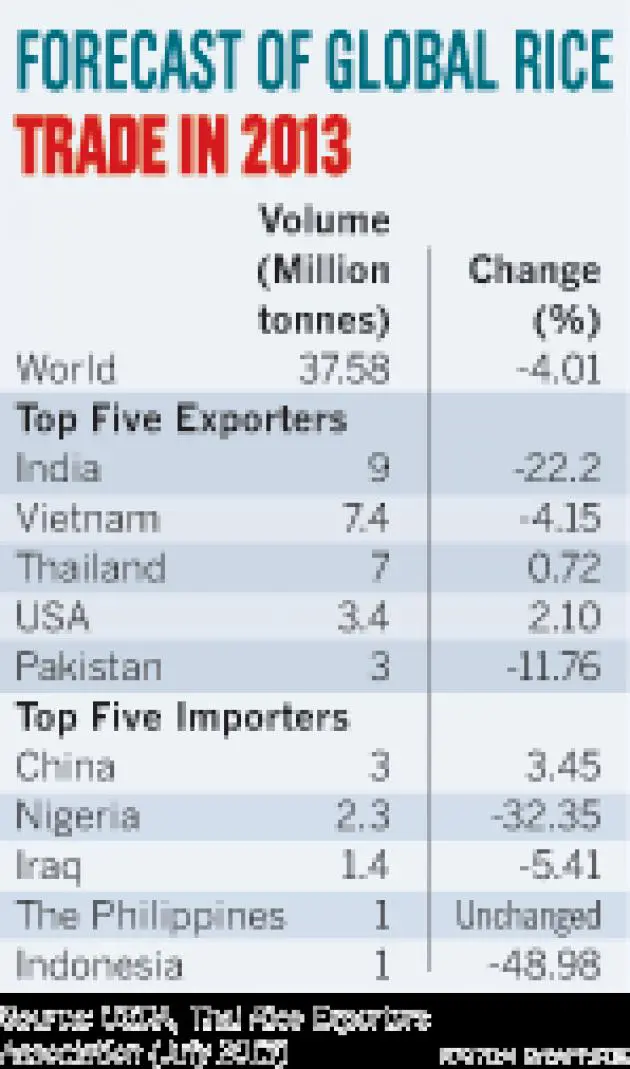
Exporters forecast that rice exports, excluding those under G2G basis, will reach only 6.5 million tonnes this year. The price of Thai rice is still high when compared with those of competitors.
