
Companies have to help themselves, while waiting for national plan


MITR PHOL has collaborated with four universities to transfer their knowledge to value-added products, chairman Isara Vongkusolkit has said.
Meanwhile at the national level, the Thai Chamber of Commerce (TCC) has set up a unit to promote research and development among private companies.
But as chairman of the chamber, which has more than 20,000 members across the country, Isara sees the necessity of a national agenda that also covers non-R&D areas if Thailand is to enhance its competitiveness on the international stage.
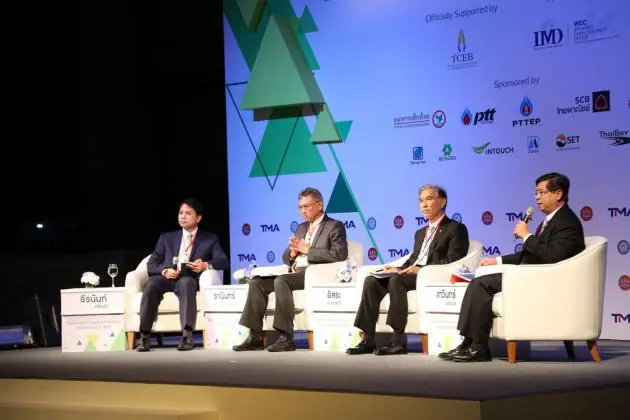
“Pushing for awareness [of the need for improved] competitiveness is hard without joint cooperation. Yet while private companies are more flexible, the government is slow in making decisions,” he said at a conference last week sponsored by the Thailand Management Association (TMA).
“For now, private companies have to help themselves; for instance, in the education field, as Thailand is investing more overseas, we see that only 10 per cent of the workforce is ready to support this.”
The TCC and the TMA are now in talks on hosting training programmes and exploring the possibility of introducing technology to assist business expansion.
According to TMA chairman Tevin Vongvanich, the good news is that some strategies have been shaped, and are only waiting for joint implementation by the government. The focus is on six industries that have a lot of room for improvement, including the automotive sector. After expanding in the past decades, the sector’s potential can be raised with its own technology.
Tevin told the audience the focus of the Thailand Competitiveness Enhancement Programme “would be on R&D, green energy, corporate social responsibility and sustainability, and human-capital development”.
“Failure comes from bad strategies, but success comes from good execution,” he said. “Our strategies have been poorly executed in the past as there was no focus.
“In the public sector, there are too many projects. Thailand had no social consensus on which direction we should go. Among private companies, not all have sufficient resources to strengthen themselves.”
He said the best way forward was the realignment of the mechanism. State agencies will need to create a single-line operation system, to improve cooperation. Meanwhile, there should be a bridge between the public and private sectors.
He added that it was worrisome that small and medium-sized enterprises were unprepared for change. There is a big gap in terms of preparedness between large corporations and SMEs. Once the Asean Economic Community starts, these SMEs will be in trouble, and this could spark social repercussions.
“Human capital is a key. Without cooperation of the public and private sectors on this, we can’t benefit from our growth drivers,” he said.
To support the wave of overseas investment by Thai companies, the TMA now assists on training programmes to prepare mid-level executives. To promote the greater use of technology, big corporations also seek assistance from such organisations as the National Science and Technology Development Agency. Tevin also promised that the TMA would facilitate the transition.
Thanin Pa-Em, director of the Competitive Development Office of the National Economic and Social Development Board, revealed at the event Thailand’s plan to jump to 16th in the Switzerland-based IMD World Competitiveness Centre’s ranking by 2024 from 27th currently.
To achieve this, government agencies will have to change their operating systems. In terms of investment promotion, the Board of Investment will need a clearer focus on how it selects the industries it supports, as the country cannot afford “one size fits all” promotional privileges.
If Thailand is to promote green energy and information technology, more needs to be done, he said. Meanwhile, as the BOI focuses its policy on promoting overseas investment, the Commerce Ministry will need to see how it can help.
At the TMA conference, IMD pointed out that low spending on R&D in the private and public sectors was one of the crucial weaknesses of Thailand, and why it ranked 27 in the competitiveness index of 60 economies. Political instability, inefficient SMEs, and corruption was also holding the country back. However, Thailand’s ranking did move up this year from 30th in 2012, when it fell from 27th in 2011.
