
BAAC wants central unit to monitor expenditures of pledging scheme
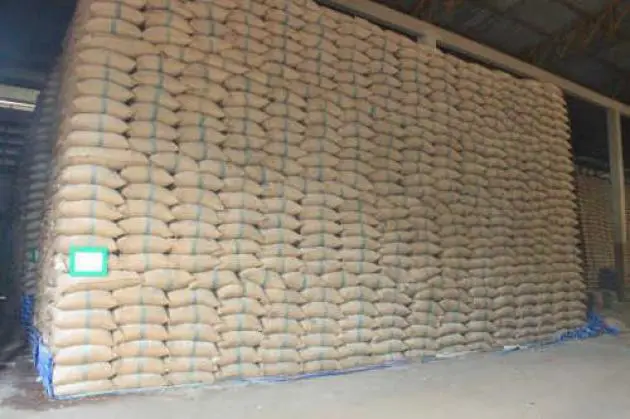


The Bank for Agriculture and Agricultural Cooperatives has urged the government to set up a central unit to control the costs of the rice pledging scheme, and to ensure that farmers are actually getting the money meant for them under the programme.
BAAC president Luck Wajananawa said the problem with the much-criticised pledging project was not the amount of money put into it, but lack of clarity on how much of that money was directly benefiting farmers.
A central unit such as the Office of the Prime Minister should monitor the programme’s spending, he said, adding that implementation now poses a more serious trouble to the scheme than funding.
The Finance Ministry’s subcommittee tasked with estimating the spending involved earlier estimated that losses in the 2011-12 harvest year would rise to Bt122 billion or about 36.2 per cent of the Bt337-billion pledging amount.
"If we can accept such a loss, we have to prove clearly that the amount was really paid to farmers. There must be a middleman to work on inspection of the project to gain confidence from the general public," Luck said.
If the money were paid directly to farmers, that could gain people’s confidence and create spending power to fuel the economic system, he said.
The Finance and Commerce ministries and the bank are discussing a plan to find money for the rice pledging scheme in the 2013-14 production period that starts next month. The result is expected in the next day or two. The Cabinet set a budget of Bt270 billion for this period and Prime Minister Yingluck Shinawatra prefers that the scheme use money from the Commerce Ministry’s rice sales rather than borrowing more.
For the 2014 fiscal year, the Public Debt Management Office will put in place a credit guarantee worth Bt250 billion for the scheme if the ministry cannot sell enough rice in time.
In the initial period, no more than Bt8 billion is expected to be allocated for the scheme, with the highest spending next January, he said. The Cabinet has resolved to limit this year’s pledging amount to Bt500 billion.
Luck said the government spent Bt667 billion, about Bt167 billion higher than that limit, for rice pledging in the past four production periods. However, it is expected to keep the amount within the limit.
He said that in fiscal 2014, the bank would be allotted a budget of Bt82 billion to repay previous projects’ debts. The amount will be used to finance the bank’s operations, particularly involving farmers who do not rely on the government.
"We are worried about our customers, particularly those in the sugar-cane and sugar industry, because of drops in the global prices of sugar. And this could affect the minimum price of sugar cane and sugar that will be announced in the next two weeks," Luck said.
The BAAC is also in charge of distributing the government’s subsidies to rubber growers. The Cabinet earlier approved a total budget of Bt21.21 billion and a sum of Bt5.04 billion has been allocated to the bank.
Luck said 1,000 growers in Nakhon Si Thammarat received the subsidy yesterday and within a month and a half all 997,177 rubbers would be paid.
