
Sufficiency key to healthy living


Play
HM's philosophy "is pathway leading to sustainable development"
His Majesty the King’s sufficiency economy philosophy is the very pathway leading to sustainable development, Professor Stephen B. Young said at a conference in Bangkok last week.
“The realisation of the Millennium Development Goals (MDGs) rests on our genuine actions right from this moment. After 2015 we must set new goals for sustainable development by adhering to sufficiency economy philosophy initiated by His Majesty the King on the basis of moderation, reasonableness and immunity or risk management. This Royal philosophy has proven in Thailand its capability to drive sustainable development without posing any conflict to business practices,” said Young, global executive director of Caux Round Table (CRT).
He was speaking at “The 2013 Bangkok Conference: Global Dialogue on Sustainable Development” hosted last Thursday by CRT – an international organisation advocating sustainable development and moral capitalism – plus the Thai Chamber of Commerce, and Thailand Development Research of Thailand (TDRI). The conference aimed to place emphasis on moral ethics for the first time in Asean.
“I strongly urge every social sector to jointly nurture moral capitalism for their future generations and propose that the business sector earnestly adopts ‘Honeybee Capitalism’ to uplift their social responsibility degrees,” appealed Young.
Young said capitalism guided by ethics and good governance would result in sustainable business prosperity as well as social well-being and environmental growth.
“Future sustainable development accomplishments need our all-out collaboration, not merely business executives, but also communities and individuals – be they men, women, or children. They must exploit their full potential with moral ethics to effect changes. Using sufficiency economy philosophy as the guiding principle for self, community and business development will assure us of a secure future for our next and unborn generations, making possible a systematic change around the world when put into practice in numerous communities,” he asserted.
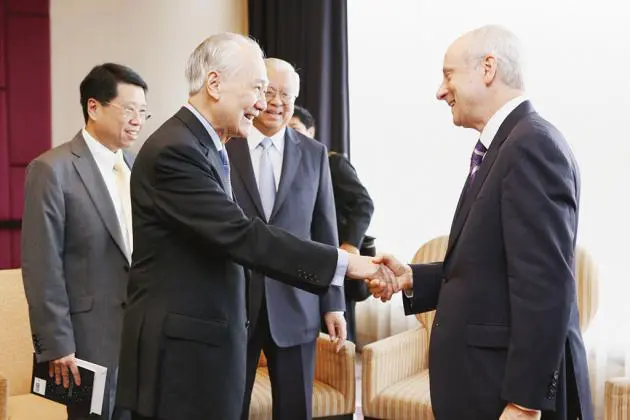
Also joining the conference was Prof Michael Sandel of Harvard University, renowned for his concept of moral capitalism and moral limits. “We must seek joint solutions by reasoning together and giving others the right to be heard, or else we cannot build a basis for social justice that people can agree upon,” he said.
Former PM Anand Panyarachun, Unicef Thailand Goodwill Ambassador and chair of the conference, cited in his opening remarks three global crises – worsening environmental changes, the ill effects of unbridled capitalism, and chronic hunger, suffered by one in eight of the world’s population.
“A mindset based on core-values shared among the responsible parties in managing sustainable development, institutional frameworks and addressing inequality, is of pressing importance. Success and sustainability in the next phase of development, both at the global and the community level, depends on our actions today,” Anand said.
Dr Noeleen Heyzer, under-secretary-general of the United Nations and executive secretary of the UN Economic and Social Commission for Asia and the Pacific, affirmed that no country or region could succeed without governments, business, and people embracing a new spirit of human solidarity, shared responsibility, and mutual benefit. “The new global partnership for sustainability and inclusion is centred amid four transformative shifts,” he said.
More than 1,000 Thai and global business executives, experts and civil society took part in the one-day event to jointly seek pathways for Thailand and the world to drive sustainable development in alignment with the globally recognised sufficiency economy philosophy and the Tenfold Kingship Virtues of Thailand.
The sufficiency economy philosophy has been hailed as a new value-based view of capitalism that promotes justice, moral economics and moderation. It is a mindset that can renew capitalism and ensure that our resources will be used in a sustainable way, allowing our children to also enjoy them.
