
Securities houses upbeat despite tougher market


Play
Major securities firms are largely unfazed about this year's tougher market conditions - namely, more intense competition resulting from the increase in the number of brokerages, and the effects of the political turmoil during the first six months.
The political situation in particular contributed to a sharp drop in first-half market volume when compared to the same period last year.
ML Thongmakut Thongyai, chief executive officer of SCB Securities, said that despite factors affecting the economy in the first half – when average daily market volume fell 27 per cent to Bt32 billion – and established brokerages losing market share to new players amid lower trading volume among retail investors, his company had still been able to cope.
In fact, the company is expecting the market to rebound during the latter half due to the current economic recovery and the return of private investment, he said.
“Despite the increase in the number of brokers and a drop in market volume in the first half, SCB Securities still saw an increase in market share and, for the second half of the year, the company’s strategy is to continue pursuing synergy with parent company Siam Commercial Bank to boost marketing effectiveness in tapping retail clients,” he added.
SCB Securities forecasts the average daily market volume of the Stock Exchange of Thailand (SET) in the second half to be in a range of Bt38 billion-Bt40 billion, and a whole-year daily average of Bt35 billion.
The company’s prediction for the SET Index is that it will stand at 1,600 points by year-end.
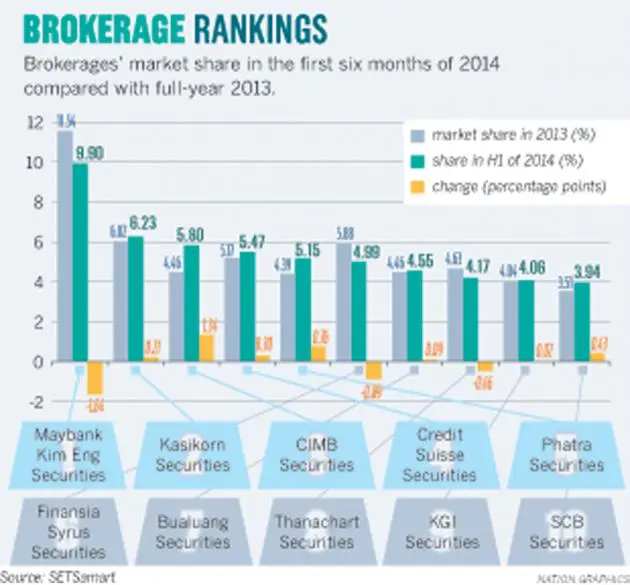
Boonporn Boriboonsongslip, co-chief executive officer of Maybank Kim Eng Securities (Thailand), said the market was very competitive this year due to the increase in the number of competitors, which had led to a drop in its headcount and market share.
However, the company is one of the least affected by the situation, he said.
“It is true that our industry is very tough and very competitive this year,” he said.
“But, if we look at changes in the number of independent contractors (ICs) at each brokerage, it can be seen that new brokers have acquired a couple of hundred ICs. Maybank Kim Eng, on the other hand, has lost only a few ICs, and its change in the number of ICs is the lowest among all the brokers,” he added.
Boonporn said Maybank Kim Eng’s market share had dropped quite sharply at the start of the year, from 11.5 per cent at the end of 2013 to around 9-10 per cent in May, due to the increase in institutional participation in the market during the opening months – from 43 per cent last year to 48 per cent in the first quarter.
Political uncertainty contributed to the decline in market share, since retail customers – Maybank Kim Eng’s main business – were unsure about the market’s direction.
However, since the political situation became clearer and market confidence returned, the company’s share has bounced back to around 11-12 per cent and is continuing to increase, he said.
Kongkiat Opaswongkarn, CEO of Asia Plus Securities, said the increase in competition was normal in securities business, and the current number of brokerages was still much less than the 100 or so securities firms prior to the Asian financial crisis in 1997.
There are currently 42 securities houses in Thailand.
He said market share was a like a blade with two sharp edges, and brokerages should work to diversify their products and concentrate on their customers and net profit, rather than on getting more market share if they did not want to be viewed as a “discount broker”.
