
Asia Cement strives for sustainable society


Play
More focus on environment, education and contribution to the communities near its plants
Environment, education and society are the key to drive business growth in the long term, Asia Cement Co co-managing director Roberto Callieri said in an interview to The Nation last week.
Callieri, who also zone director-Asia of Italcementi group, which is a major shareholder of Asia Cement Co, said the company’s corporate social responsibility focuses on three areas: innovative and environmental; education; and, social community.
For environmental, the company is striving to make changes in the way it does its business, especially reducing CO2 emissions from the cement plant in the manufacturing process. It has also adopted a policy to manage its manufacturing plant so as to reduce waste in the environment and also reduce electricity consumption. The company has invested Bt1.3 billion to build a waste heat recovery and power generation plant that opened last year.
The plant is using state-of-the-art technology, which can generate electricity without the use of traditional fossil fuels. The waste-heat recovery and power generation plant can also thereby reduce heat, dust, pollution and is completely environmentally friendly.
The Waste Heat Recovery and Power Generation Plant generates electricity by using the residual heat generated from the clinker burning process. Instead of releasing this heat into the atmosphere, the hot gases are used to generate steam in the boilers, which in turn is sent to a steam turbine that drives an electric generator to produce electricity. This will help reduce energy costs in accordance with the principles of renewable energy while also minimising the use of fossil fuels, a way to develop clean energy that can effectively help the reduction of greenhouse gas emissions, he said.
In numbers, this state-of-the-art 21-megawatt power plant can produce 150 million kilowatt per hour per year without using fossil fuels, reducing carbon dioxide production by 120,000 tonnes per year, equivalent to the reforestation of 150,000 rai of land.
Meanwhile, the company also manages its production processes to have an efficiency that will reduce waste from the production process. The company is also researching and developing innovative products, which are also green products. This supports its business goal to be environmentally friendly.
The company has expanded the idea to install 4 kilowatts on-grid solar PV rooftop panels to be used alongside electricity distributed by the Provincial Electricity Authority (PEA) in small and medium-sized schools situated around the company’s cement plants.
The company kicked off this project early this year to celebrate 25 years and calls it the ‘25 Renewable Energy Schools Project’. The programme aims to build 25 renewable energy schools in 2016. This year, of the 10 schools it plans to build, three are ready, he said.
The company is pursuing the concept of renewable energy schools by installation of 4Kw on-grid solar PV rooftop panels. When a school sets up the solar PV rooftop, electricity bills will reduce by approximately 80 per cent to 90 per cent, thus allowing the school to increase its annual operating budget by 13 per cent to 16 per cent.
Furthermore, participating schools serve as learning centres on renewable energy for locals to learn and apply to their daily lives, he said.
Besides building the solar PV rooftop panels, the company has also prepared educational handbooks on various scientific topics such as electricity from solar energy, renewable energy, energy production and environmental protection, and energy conservation. These are distributed as teaching and study materials.
Callieri said that despite the fact that solar energy had been used for sometime, such technology is still new in Thailand due to high installation costs. The company has spent approximately Bt7 million on its latest project and was able to reduce electricity cost by Bt720,000, which equates to 90,000 kilograms of carbon dioxide per year. Most importantly, the company has been able to educate and instil a sense of responsibility in future generations, which is invaluable.
This project not only helps a school reduce the electricity bill, but provides them the education to use alternative energy and also teaches the children to know and use technology. This is a project that supports the education of the community, he said.
The “25 renewable energy schools project” starts this year, focusing on schools located close to its three plants in three locations, including Phra Phutthabat district in Saraburi province, Takli district in Nakhon Sawan province, and Cha-am district in Phetchaburi province.
From three locations, Callieri said the company would expand in others locations in the future. This is a part of its CSR education programme.
Meanwhile, the company also supports the communities around its cement plants by focusing on activities that can create quality living for the people.
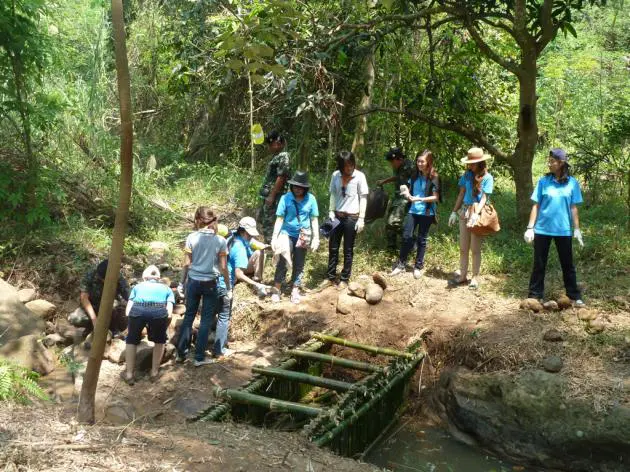
For instance, the company has been conducting the Youth for Environmental Protection Camp since 2011. The camp’s objective is to promote better understanding of the environment so as to instil in the youth an understanding of the problems, leading to better solutions for the environment.
The project gives students exposure to these issues and the chance to return to their families and communities to share their knowledge regarding the importance of the environment.
The company also provides scholarships for children who stay around its cement plant.
“Our CSR strategy focuses on environment, education, and community that has to go together to be a sustainable society,” he said.
