
CEOs upbeat over economic outlook


Play
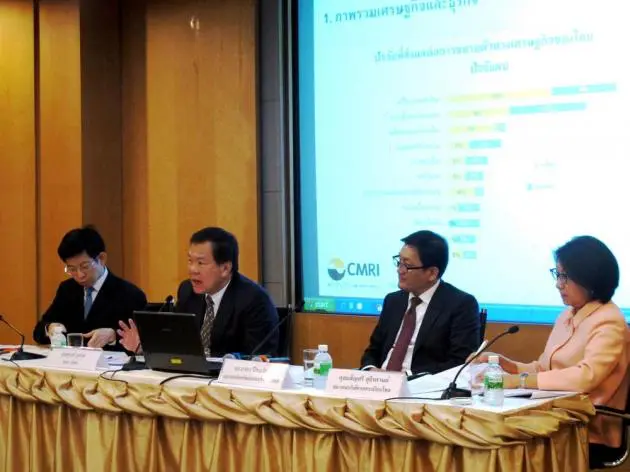
THE LATEST quarterly survey report by the Capital Market Research Institute (CMRI) shows that the majority of CEO respondents at listed companies have a positive sentiment on the country's economic outlook during the next six months, and are preparing to
However, there are concerns among the chief executives regarding long-term issues in terms of the current shortage of skilled and unskilled labour, the high level of household debt, and uncertainties surrounding the implementation of government economic policies and the political situation next year.
The latest “CEO Survey” report – the result of collaboration between the CMRI and the Thai Listed Companies Association – was conducted in the third quarter.
It had a sample size of 77 chief executive officers out of the 650 companies listed on the Stock Exchange of Thailand and the Market for Alternative Investment, with their firms having combined assets worth 33 per cent of overall stock-market capitalisation.
The survey shows that 92 per cent of CEO respondents believe the Thai economy will improve in the next six months, with 77 per cent saying it will be “slightly better” and 15 per cent saying it will be “much better”. Just 8 per cent said it would be “the same or worse”.
Pakorn Peetathawatchai, SET executive vice president and head of its corporate strategy and finance division, yesterday said the quarterly survey anticipated a sound economic recovery, thanks to political stability and the return of fiscal policies, along with the acceleration of government spending.
1.5%-plus growth seen
Some 66 per cent of the respondents expect the economy to grow more than 1.5 per cent this year, and 88 per cent of them aim to invest more in the next 12 months through bank loans and retained profits, he said.
Twenty-three per cent of the CEO respondents also expect their liquidity level to improve in the next six months, while 29 per cent believe they will have to employ more workers due to expected expansion.
However, there are negative factors CEO respondents believe can hamper the economic recovery, such as the high level of household debt, which is depleting people’s purchasing power, and the shortage of labour, which hampers companies’ ability to expand.
Some 60 per cent of the respondents highlighted a lack of skilled labour as their biggest concern.
“The real sector is still vulnerable to the political situation, since listed companies are still wary about this issue, along with concern over a labour shortage in the future. It is interesting when listed companies say, ‘Other concerns are not so relevant, apart from when will the political situation be stabilised and where am I going to get the labour from if I am going to expand in the future, or will the workers be suitable for what I am going to do?’” Pakorn said.
Regarding the country’s reform moves, he said two-thirds of the participants placed importance on cracking down on fraud and corruption, reforming the political system and bureaucracy, and implementing government spending.
Kiatipong Ariyapruchya, the CMRI’s director, said the majority of CEO respondents’ concerns were long-term issues that reflected the apparent recovery of the economy. They are more concerned over how to prepare for future endeavours than about current problems at hand, he said, citing as examples how to increase the level of research and development to create value-added products and how to expand their business outside the country.
Pakorn said it was good news that listed companies were preparing for any future economic turbulence by aiming to increase their production and labour efficiency, creating more value-added products and services, increasing investment in R&D and expanding abroad, while practising a niche-market strategy along with finding new export channels.
The survey found that 43 per cent of CEO respondents’ companies generated revenue from exports, and that 66 per cent of them believe their overseas sales will improve in the next six months.
Some 24 per cent said they shipped to the other four members of the Asean 5 (the Philippines, Indonesia, Malaysia and Vietnam), while 17 per cent sold to CLMV countries (Cambodia, Laos, Myanmar and Vietnam), and 15 per cent exported to China.
Sixty-one per cent of CEO respondents said their companies had invested abroad, while 11 per cent said their overseas investment outpaced their domestic investment. Meanwhile, 42 per cent are planning to increase their foreign investment.
Some 35 per cent of the surveyed companies venturing abroad have done so within the Asean 5, while 28 per cent have done so in CLMV countries, and 15 per cent in China.
“Some 110 Thai listed companies have sources of income from abroad, and around 40 per cent of their revenue is from other countries. This shows that listed companies are not the same as they were five or 10 years ago … and their risk management in regard to cash flow, interest rates and exchange rates is also more efficient. I have never seen a survey in which 48 per cent of the companies say they have a risk-management programme for exchange-rate volatility,” said Pakorn.
