
Cross-border M&A still low despite approach of AEC


Play
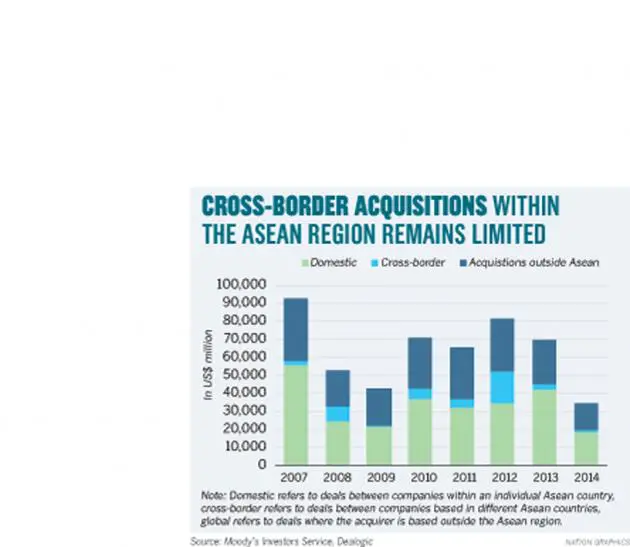
Since the Asean Economic Community (AEC) initiative was launched in 2007, there has been no material pick-up in regional cross-border acquisitions, despite intra-Asean foreign direct investment increasing from 3 per cent to 28 per cent of total FDI, accor
Between 2004 and 2014, cross-border acquisitions within the Asean region represented just 9 per cent of total acquisitions by Asean-domiciled companies, compared with 55 per cent for domestic acquisitions and 36 per cent for acquisitions outside the region, according to the “Inside Asean”, a quarterly publication looking at major credit trends prevalent in Southeast Asia.
The share of cross-border acquisitions is significantly lower than the share of intra-Asean trade, which has been stable at around 25 per cent.
The report noted that potential delays to AEC implementation could hold back Asean cross-border activity. While the AEC is scheduled to be in place by the end of next year, member countries have yet to make significant headway in areas such as eliminating non-tariff barriers, reducing cross-border investment obstacles and improving labour mobility.
Until further clarity on such pertinent issues materialises, Asean companies may be tempted to hold off on large-scale intra-regional investments despite the secular story of increasing trade integration.
Companies with easy access to funding in Singapore and Malaysia dominate cross-border acquisitions. Sixty-nine per cent of the cross-border acquisitions within the Asean region were initiated by companies based in one of those two countries. Companies there benefit from lower funding costs and deeper financial markets to expand within the region.
The rating agency opined that deeper financial integration would help Asean companies’ regional expansion. Asean financial markets remain fragmented, given the wide disparities in areas such as domestic regulation and corporate governance.
Currency and interest-rate differentials are also significant risk factors that limit the availability of funding for regional expansion.
On the contrary, Asean companies have been able to fund their global expansion easily because of low dollar funding rates and favourable liquidity conditions (although this has led to an increasing foreign-currency debt burden).
Capital-market integration is a cornerstone of the AEC, which will help reduce barriers to Asean cross-border activity over time.
The Asean Banking Integration Framework was launched in 2011 as part of the broader AEC objectives. The framework aims to achieve multilateral liberalisation in the banking sector by 2020 for Asean commercial banks. It does so through liberalising capital accounts and domestic financial markets in individual countries, regulatory harmonisation, and stronger policy coordination among the member states.
The framework is part of the Asean Economic Community Blueprint, which promises to bring economic benefits and financial stability to the region through multilateral liberalisation by 2015.
In this area, debt markets in the six Asean economies of Indonesia, Singapore, Malaysia, the Philippines, Thailand and Vietnam are expected to register sustained growth in both domestic and cross-border issuance in 2015, after a gradual return to form since volumes fell in mid-2013, Moody’s Investors Service says.
“Generally supportive macroeconomic and market conditions, and the implementation of Basel III capital requirements, will provide a favourable backdrop for issuers to tap the market,” said Rahul Ghosh, a Moody’s vice president and senior research analyst. Moody’s expects real growth of gross domestic product to accelerate across the region next year, as political risk subsides in Indonesia and Thailand, and Vietnam emerges from a period of external rebalancing and banking-system instability.
