
Germany 'ready to share EU lessons as Asean integrates'


Play
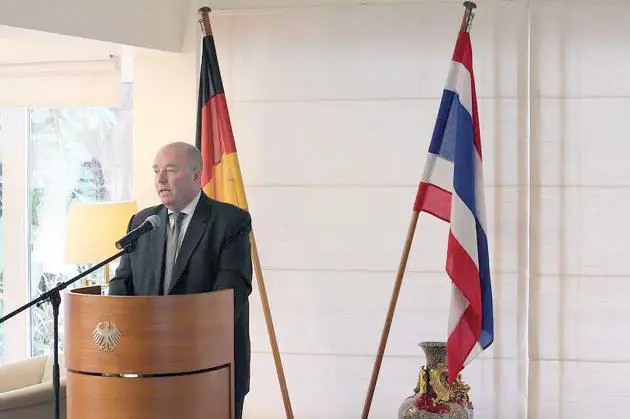
The success of regional cooperation takes time while investment in renewable energy and education is the name of the game when comes to sustainable development, and Germany is preparing to share its experiences with these issues, Rolf Schulze, the German
“One lesson learned from the European Union is that integration and closer international cooperation are a step-by-step process. It’s a process that does not come overnight. It’s a process with learning by doing, and it’s give and take,” he said regarding the launch of the Asean Economic Community (AEC) next year.
“In a region like Asean or the European Union, it’s like in a family, where you have to accommodate the interests of all participants. No country can go at it alone and think that because we are big and we are wealthy, we can tell our friends which road to take,” he said.
Schulze said economic and trade cooperation could serve as an avenue for peace and stability in the region, as seen in the success of the EU, but development in this region from the opening of the AEC would not be rapid.
“At the end of 2015 there will be a common space with free movement of goods, services, persons, and finances within Asean, but it will not be a big-bang development and not all the liberties will be implemented overnight. It will rather be more of a phasing in of various categories, precisely the way we know it from the Europe Union, since the CLMV [Cambodia, Laos, Myanmar and Vietnam] countries will need more time to adapt to this new economic space,” he said.
The AEC will comprise one of the fastest-growing regions in the world, with a combined population of more than 600 million. This will be a very important development not only in economic and trade terms but also politically. The EU is willing to share with Asean the lessons it has learned, said the German ambassador.
He noted that among the European countries, Germany was the biggest contributor of funds to the Asean Secretariat in Jakarta.
Recently the country contributed another Bt122 million to new German-Thai cooperation projects for the next phase in the promotion of a low-carbon economy and the reduction of greenhouse-gas emissions, a project that started in 2009. The pledged amount from the Germany government for the overall project has now reached more than 7 million euros (Bt288 million) as part of its International Climate Initiative.
“Environmental protection is a big challenge in Asean but not in Asean alone,” Schulze said.
“On one hand, Asean has very robust and strong economic development and robust industrialisation, and this of course creates a lot of environmental problems. But we are in a position to remedy some of these problems, and I think Asean countries would be well advised from the very onset to do both things hand in hand in terms of industrialisation and the protection of the environment,” he said.
He noted that Thailand is a net energy importer, since it has very few energy resources of its own. Therefore to make use of renewable sources such wind, solar and biogas would be an important step, since this can lower energy costs in the long term. Germany is a good example of this approach, since 25 per cent of its energy needs are supplied by renewable sources despite being one of the biggest industrial giants in the world.
Vocational and professional training is another priority within the German-Thai cooperation projects. Germany has been in contact with Thai government agencies on the introduction of a dual-education system, which has been a success in Germany, where young students receive both classroom and on-the-job training at the same time.
Another project is a trilateral programme that aims at supporting Thailand’s neighbours and narrowing the development gaps within the region.
A third agreement concerns joint projects to increase energy efficiency and reduce greenhouse-gas emissions in the land-transport sector within Asean.
Germany has contributed 2.5 million euros more for these Asean projects and has now provided about 50 million euros overall for cooperative projects in the region.
