
Private sector needs new visions to succeed in AEC, forum hears


Play
The Thailand Management Association believes the private sector needs to adopt new visions, strategies, corporate cultures and core values while business leaders need to review their internal policies if opportunities under the Asean Economic Community ar
The TMA said these were the key requirements that needed to be addressed before the AEC’s full implementation next year.
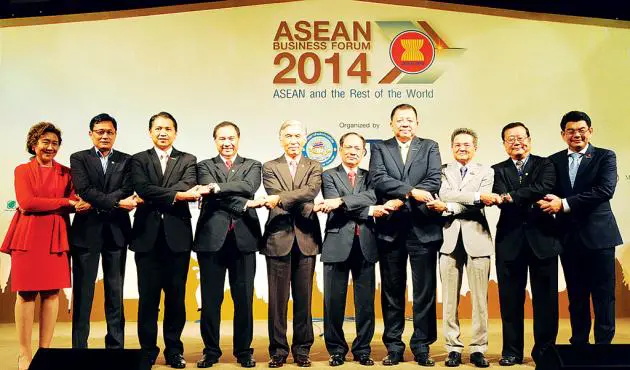
Speaking yesterday at the “Asean Business Forum” arranged by the association and the Board of Trade of Thailand, Tevin Vongvanich, chairman of the TMA’s Centre for Competitiveness, said business leaders had to take into account the context of Asean as a single market and doing business on a global scale.
Tevin said good governance and social responsibility could not be neglected if companies wanted to operate with confidence in what would be a more integrated market under the AEC.
“Business leaders will have to be adaptable because they will be working with different cultures that have different requirements and needs for customers in different markets, while collaborations with other companies are quite obvious, since we will have to work with others in this integrated market,” he said.
Tevin said companies had to capitalise on the uniqueness of each market and on the knowledge base established by companies in each country through collaborations.
They also had to encourage their personnel to familiarise themselves with other tools and resources that existed in foreign markets they wished to explore.
“The key to going from local to global competitiveness is human-resource development, which includes the development of leadership within the company,” Tevin said.
He said the key competencies and attributes that needed to be enhanced ahead of the AEC were language skills, integrity in governance, assertiveness, global perspectives and the ability to collaborate with others. Increases in skilled labour, productivity, research and development, value-added products and innovation, and improved supply chains were all prerequisites for a company to improve its competitiveness.
Tevin advised smaller companies to improve their leadership structure and technology through collaborations with the “big brother” larger companies in order to save on development costs.
Speaking at the same seminar, Pattama Teanravisitsagool, deputy secretary-general of the Office of the National Economic and Social Development Board, said the AEC would result in increased physical connectivity with neighbouring countries through investments in transport infrastructure.
But she urged the public sector to concentrate on developing the soft side of cooperation, such as the single-window idea and cross-border-transport regulations, to facilitate the integration of Asean markets.
“We talk about an Asean single window, but Thailand is still struggling in the development of a national single window, with 35 government offices and agencies still needing to integrate and develop a single system,” she said.
Pattana said cross-border-transport agreements should be pursued to facilitate cross-border trade, while a regional investment framework under the Greater Mekong Subregion should also be realised.
