
Broadcasters sharpen strategies as fiercely competitive year looms in battle for TV viewers


Play
It is too soon to say which companies will be winners and losers in the game of terrestrial-based digital television, but all digital-TV operators agree that next year will be another tough one for the broadcasting sector.
However, the country’s 23 million households will for sure have much more choice when it comes to being entertained, informed and inspired on their screens.
The Nation has learned that analog- and digital-TV broadcasters have prepared uncompromising strategies to fight for audiences in an intensely competitive environment during the year ahead.
In the overall Bt70-billion TV broadcasting industry, the Channel 7 and Channel 3 duopoly is continuing to put premium content – entertainment, sports and news – first in a bid to retain the stations’ viewer bases.
Unfortunately, underdog players like MCOT’s Modernine TV and the Army’s TV5 appear to be weaker and face a tough situation after their long-term content partners – Workpoint Entertainment and GMM Grammy – decided to shift some popular programmes to their own digital-TV channels.
Meanwhile, expecting growth in the digital-TV viewer base in the coming year, new players have each set a clear vision to see more improvement in terms of quality programming, TV ratings and advertising revenue.
High investment, limited returns
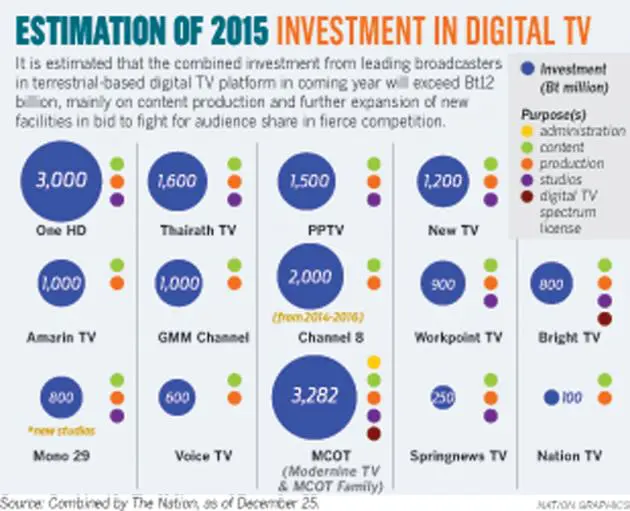
It is estimated that the combined investment of the 14 digital terrestrial TV broadcasters that have disclosed how much they will spend next year will be around Bt18 billion.
The investment will be earmarked for various costs, ranging from administration, management, employment, content development and production, to new studios and facilities and the digital-TV spectrum licence fee.
Among the digital terrestrial TV channels, GMM Grammy appears to be the biggest spender with more than Bt4 billion set aside for next year’s investment in two channels: One HD and GMM Channel.
Thakonkiat Veerawan, chief executive officer at GMM HD Digital TV Trading, said One HD needed to have Bt3 billion mainly for producing quality soap operas, sitcoms and variety shows.
Meanwhile, GMM Grammy’s co-chief executive officer, Saithip Montrikul Na Ayudhaya, who is in charge of GMM Channel, said that to attract its target audience, particularly younger people, the station had prepared Bt1 billion for content production and acquiring the rights to foreign shows.
Jitsupan Vacharapol, chief strategy and marketing officer of Triple V Broadcast – operator of Thairath TV – said her company planned to invest Bt1.6 million, mainly on content and related production. Some Bt300 million of the budget will be used to build a 13-storey studio on the grounds of Thairath’s head office.
Next year will be another year of investment for tycoon Prasert Prasartthong-Osoth’s PPTV channel.
Kematat Paladesh, president of Bangkok Media and Broadcasting, which operates PPTV, said his company had earmarked Bt1.5 billion for next year’s plans; Bt1 billion will go to new content production and foreign TV programmes, while the rest will be used for building new studios to expand its TV production capacity.
Meanwhile, Phayao Thamteersoonthorn, head of TV trading at Mindshare Thailand, suggested that digital-TV business in the Kingdom would continue to grow next year, but not that rapidly.
By the end of next year, the estimated revenue share from digital-TV business will possibly account for 20 per cent of the total Bt100-billion advertising industry, she said.
Incumbents’ strategy
Pravit Maleenont, director of BEC World, said Channel 3 would remain a flagship channel that continued providing “creme-de-la-creme shows” and killer content to retain its audience.
Expecting fierce competition from new rivals, Surin Krittiyaphongphun, executive vice president of Bangkok Entertainment Co – the operator of Channel 3 – acknowledged that it might be difficult for the company to raise advertising rates at the station. The company therefore must improve those airtime slots that currently have poor ratings, he said.
Despite facing a tough situation when it came to further increasing ad rates, Mindshare’s Phayao said Channel 3 was creating more engagement between its prime-time shows and viewers through a series of on-the-ground activities and its social-media strategy.
Bangkok Broadcasting and Television, the operator of Channel 7, could not be reached for comment, but IPG Mediabrands told The Nation that it had found an interesting improvement at the 47-year-old station.
Khanokkhan Prajongsangsri, business director for investment and knowledge at IPG Mediabrands, suggested that Channel 7 was welcoming more TV producers in a bid to offer new shows and dramas to attract more viewers in urban areas, which were currently a major stronghold of its rival, Channel 3.
Back in 2012, Channel 7 spent Bt1 billion on acquiring the media rights for international and regional sport tournaments ranging from soccer and golf to volleyball, she said. Among the key broadcasting rights acquired by the country’s favourite TV station were six consecutive editions of the biennial AFF Suzuki Cup from 2012.
New players’ strategy
Khanokkhan said that to attract particular audiences, a niche target or segmentation strategy might have to be put in place. The news-channel category is an example in this regard.
Adisak Limprungpatanakij, president of National Broadcasting Corp – the operator of Nation TV – said that not only would the seven news channels on the digital terrestrial platform compete with one another, but they also had to “catch the same eyeballs” with other digital-TV players in the variety and family categories.
To cope with this challenge, Adisak said he had prepared content and marketing strategies to expand news consumers into young audiences, aged below 30.
Another news station, Voice TV, is focusing on a similar target in the hope of expanding its audience to first-time job seekers.
