
PM sees signs of recovery, thanks to govt's policies
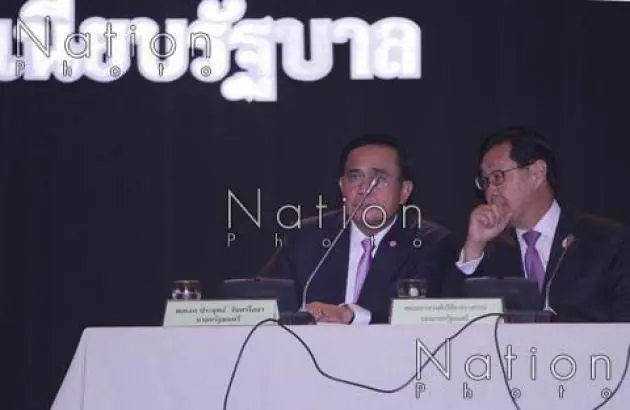


PRIME MINISTER Prayut Chan-o-cha has confidence that the economy is finally showing signs of recovery thanks to his regime's short- and long-term policies put in place since October.
At a press conference yesterday, Prayut noted that gross domestic policy grew by 2.3 per cent year on year in the final quarter of 2014, compared with only 0.6 per cent in the third quarter. The first quarter of this year saw the economy expand by 3 per cent, he said.
The government is also striving for sustainable growth, such as by developing the agricultural sector to be self-sufficient without “populist” policies. To encourage the private sector to invest more, the government will develop the country’s logistics system. It has also collaborated with other countries such as China and Japan to develop the Dawei project in Myanmar and five special economic zones in this country, he said.
Meanwhile the tax system is being restructured to help ensure the economy’s long term growth.
“The government has enough income to develop the country following the plan, but we have to restructure the tax system to allow continued investment by the new government formed after the election. The benefits of this tax restructuring are not for right now but will be apparent in a couple of years. This will help the country and the provinces develop,” the prime minister said.
Deputy Prime Minister MR Pridiyathorn Devakula added that since the current fiscal year began last October, the government had approved construction of 4,911 new factories worth Bt548.57 billion, 3,549 of which had already invested Bt343.45 billion, and employed 133,000 since the final quarter of last year.
Household spending increased by 1.9 per cent in the final quarter compared with the third, and continued to increase in the first quarter of this year, by 2.4 per cent.
Government spending also increased by 5.5 per cent in the fourth quarter compared with the third and 5 per cent in the first quarter of this year compare with the final three months of 2014. (For other figures, see graphic.)
Despite these encouraging signs, the economy has continued to register slight growth because of the impact on the export sector due to the struggling global economy.
As well, Pridiyathorn acknowledged that prices for some agricultural produce such as rice and rubber were weak, and the government also has a policy to support them.
For rice farmers, the government has approved a budget of Bt38.88 billion to pay an average of Bt1,000 per rai (1,600 square metres) to rice farmers, as well as 3,051 village funds of Bt1 million each for those communities facing repeated drought.
For rubber farmers, the government has been doling out subsidies of Bt1,000 per rai, with 767,518 farmers benefiting so far. It has also set up a budget of Bt10 billion for institutions to buy rubber from farmers. Another Bt10 billion has been allocated to pay rubber farmers an average of Bt100,000 each who join a programme to switch to other crops such as oil palm.
