
KSecurities expects improved exports, consumption to boost economy in H2


Play
KASIKORN SECURITIES be-|lieves that the SET Index could |reach 1,600 points by the end of the year, as the economy will improve in the second half on expected increases in exports and domestic consumption.
The securities firm and the head of the Stock Exchange of Thailand also commented yesterday that the slowdown of the capital market in the current quarter should not be seen as out of the ordinary, as it was the season for stock-market correction.
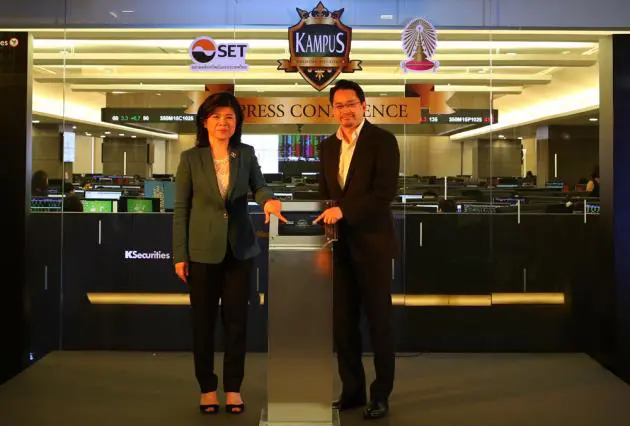
“Investors should hold on to good-fundamental stocks for more than the next three to six months, as I believe the Thai stock market should rise in the second half on an improvement in the country’s economic performance,” Kavee Chukitkasem, assistant managing director of KSecurities, said at the launch of the company’s “KS Kampus Year 2” investment training programme.
He said the recent deprecation of the baht arising from the consecutive cuts in the central bank’s policy interest rate should help exports expand in the second half of the year, after a contraction in the first four months.
Along with increasingly tangible government spending on investments, this would lead to higher consumer confidence and eventually to an increase in domestic consumption in the final two quarters, he said.
KSecurities projects the Kingdom’s gross domestic product will be able to expand by 2.8 per cent this year – below the International Monetary Fund prediction of 3.7 per cent. The baht is expected to be trading at around 34 per US dollar at the end of the year, against the current value of 33.60-33.70.
Kavee expects the SET Index to hit bottom at 1,450 points this year, while listed companies’ financial results in the first quarter are “not going to be as good as most people expect”.
KSecurities has lowered its earnings-per-share prediction for Thai stocks in 2015 from Bt110 to Bt100, he added.
SET president Kesara Manchusree said: “Investment in the capital market has currently slowed down, but this is only temporary and there is no irregularity in terms of selling out.
Oil and baht
“Investors should wait and see the performance of listed companies in the first quarter, and they should discuss with their brokers which stocks would benefit from a weaker baht and higher oil prices.”
Meanwhile, Nalin Chutchotitham, an economist at HSBC Thailand, said the bank expected the Kingdom’s GDP to expand by 4.1 per cent in the first quarter, which is lower than its earlier forecast of 4.7 per cent because of disappointing economic data.
However, the economy should be able to “narrowly escape a sequential contraction”, she stressed.
Nalin said indicators of private consumption had barely grown in the first quarter, partly because of households’ high leverage and weak confidence.
Meanwhile, some private investment plans seem to have been put off because of overall weakness of domestic and external demand.
In addition, the government’s investment-budget disbursement was weaker than planned, despite the acceleration of regular-budget spending, said the economist.
Nevertheless, Nalin said net exports would likely continue to make a positive contribution, helped by a sharp fall in imports, and the stronger-than-expected rebound in tourism should allow the country to avoid a technical recession – that is, a quarter-to-quarter contraction from the final three months of last year.
Despite lowering its first-quarter prediction, HSBC has maintained its full-year GDP-growth forecast at 3.6 per cent, and expects the policy interest rate to stay at 1.5 per cent until the first half of 2016.
“If first-quarter growth turns out close to our estimate, confidence should gradually improve. And, while we note that risks are still biased to the downside, we will wait for the official data before assessing our annual growth forecast,” she said.
