
ITC turning carbon dioxide into a hero
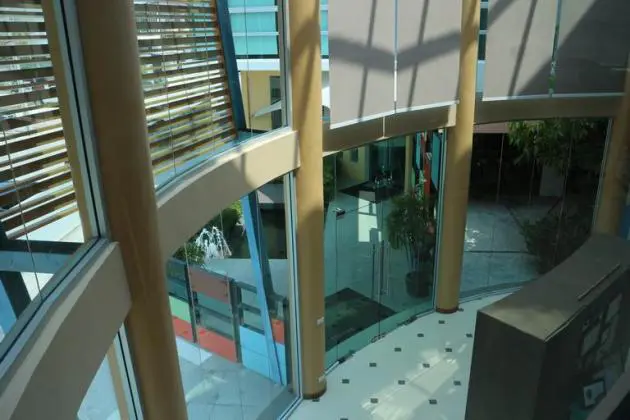


Environmentalists regard carbon dioxide (CO2) as a villain, but at ITC Group, a refrigeration company, the gas is a hero.
It helps cool the company’s headquarter even when midday temperatures in Bangkok exceed 40 degrees Celsius, and concurrently saves electricity bills and the environment.
"This is the only building in Thailand that is cooled by CO2," claimed ITC executive director Apichai Lumlertpongpana. "We are dealing with refrigeration technology. We want to maintain the competitive edge in terms of innovation. This building reflects our image as an innovative company that is concerned about global warming."
The technology is built on knowledge the company has acquired over three decades of operations. In the industry, dry ice – the solid form of CO2 – has been widely used to bring down temperatures. It inspired engineers at the company to keep the gas in a chamber and turn it into an environmentally-friendly refrigerant.
At the 3,000-square-metre headquarters on Ramkhamhaeng Road, the 100sqm ice bank is on the ground floor. It is filled with water and cooled by stainless-steel pipes full of CO2. It takes the company 10 hours to freeze the chamber at night, using electricity. Once office hours start, the electricity is turned off and the chilly air is transmitted to all parts of the building.
The whole system was designed by the company’s engineering team.
Apichai, also an engineer, noted that CO2 was one of three natural refrigerants, aside from ammonia and propane. However, propane is highly flammable, while ammonia can discharge undesirable smells; neither is a good choice for a building in a densely populated area. The company thus decided to opt for CO2.
The ice bank has resulted in two tangible benefits for the company, he said.
Buildings require electricity for lighting and air-conditioning, with the latter consuming 73 per cent of the energy. At ITC Group, the ice bank completely replaces air-conditioners.
Based on the data from the Electricity Generating Authority of Thailand, a normal building of the same size consumes 21 kilowatts per hour per square metre. Thanks to the ice bank, this building consumes 16kW per square metre, which is 30 per cent lower, he said.
Moreover, electricity bills are lower as power is used only at night when off-peak tariffs are applied.
"Roughly, our break-even point for the investment is 2.6 years," he said.
Another benefit, this one to the planet, is reduced CO2 emissions. The construction of conventional buildings always requires trees to be cut and, once constructed, they require electricity for the cooling system. These activities generate CO2. At the company, the amount of CO2 reduced in the air-conditioning process is equivalent to planting 6,700 trees.
"We regard CO2 as a villain. Yet we have let it walk freely, when the gas should be locked up for life. Indeed, seen as a person, CO2 has a good and a bad side. It has its moments," he noted.
The environment-friendly innovation has been entered for the Thai Energy Award competition and it is tipped to represent Thailand for the Asean Energy Award.
Apichai said the company was willing to share its knowledge with others. Once a month, interested students and businesspeople can book a tour.
Complaining about the intensifying heat, he said the more CO2 emissions are cut, the better the world will be.
As it requires 10 hours to get the ice bank ready, the technology is suggested for buildings that operate within specified hours, such as office buildings and shopping malls. A hidden benefit is that in case of fire, water in the tank can be used to extinguish the blaze. The key is that the ice bank should be incorporated in the designing stage to ensure its efficiency.
Established in 1982 by a group of young engineers, ITC Group has designed and supplied industrial refrigeration, freezing and cold-storage systems to several companies in Thailand and customers in some Asean countries. It is competitive within Asean, with its own design and installation teams, supported by its own technology.
