
Investment 'key to growth'
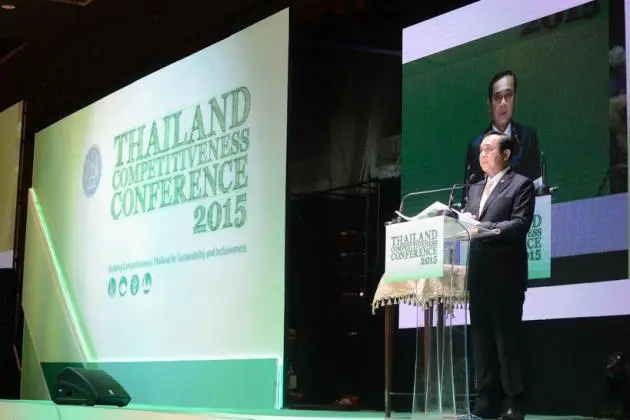


Bank of Thailand Governor Prasarn Trairatvorakul said yesterday that the economy was still on track to deliver 3percent expansion this year but could be derailed by the drought, while over the long run the country needs to invest to accelerate growth and
"The central bank still believes the economy will be able to expand by 3 per cent but there is a downside risk from the ongoing drought, as nobody really knows when the seasonal rain will come, and that means that the expansion might be slower than expected," he said.
"The drought situation was not accounted for in our 3percent prediction," he added.
"There is no significant risk to the economy in the second half of this year and the disbursement of the government’s budgets should improve," he told reporters after voicing his views at the "Thailand Competitiveness Conference" arranged by the Thailand Management Association.
Prime Minister Prayut Chanocha, who presided over the opening of the seminar, said the push to enhance the country’s competitiveness was one of the national priorities.
It requires private effort at the institutional development level, government effort at the regulation level, raising the quality of human resources through improvement in education, and the creation of mechanisms that will scrutinise and ensure the effectiveness of longterm development.
Thailand ranks 30th out of 61 economies on the International Institute for Management Development’s (IMD) World Competitiveness Ranking. This is a drop of one rung from last year.
Prasarn said Thailand’s public and private investment was small and lower than the pre1997crisis period and in neighbouring countries. The country has to invest if its competitiveness is to increase.
"Combined private and public investment is at 22 per cent to GDP, where 5 per cent is public investment, and if we want the country’s economy to expand by 45 per cent, then we will have to invest about 26 per cent of GDP," he said.
Jose Caballero, research fellow at the IMD’s World Competitiveness Centre, said Thailand should continue to take infrastructure development to the next level. That implies that government policies and business practices need to focus on the development of the workforce in terms of different skill sets that are moving away from labourintensive to valuecreation.
"Increases in the research and development budget, improvement in the scientific structure, promotion of vocational schools and computer education, improving reallife education and the quality of life of the workforce through internships and apprenticeships are all needed, and there are different ways of doing it," he said.
"The population in Thailand needs a better quality of life.
"The health system, which is not universal at the moment, is also another one of our main concerns because if you have a workforce with a good quality of life, then it will allow people to take risks in their jobs.
"If Thailand has more of an entrepreneurship mentality, then the country will improve in the long term," Caballero said.
