
Thai shares face more bad news


Play
The slide in the Stock Exchange of Thailand index continued Monday, due to a series of bad news that ranged from falling oil prices and continued contraction in Thailand's exports.
The SET index ended 25.53 points or 1.78 per cent lower. It closed at 1,412.55 points on turnover of Bt40 billion.
The index has been down for ten consecutive days. In this round, it has shed a total of 78.1 points or 5.24 per cent, compared to the July 13 closing of 1,490.65 points.
Analysts attributed the fall to a series of bad news.
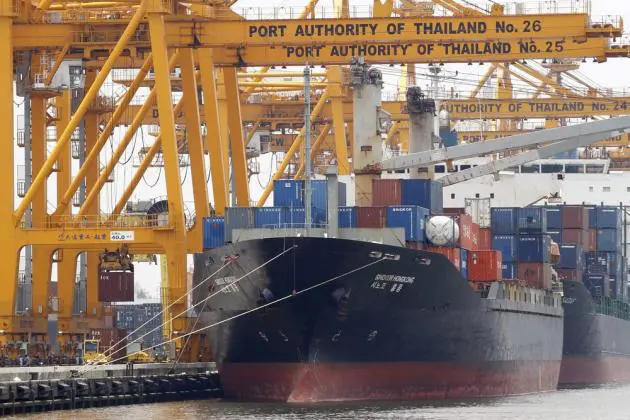
The Commerce Ministry's data showed that Thailand's exports continued to nosedive in June. The export value dropped by 7.87 per cent from the same period last year to US$18.16 billion. It is the sixth straight month of contraction.
Imports also contracted by 0.21 per cent to $18.12 billion.
In the first six months, aggregate export value dropped by 4.84 per cent on year to $106.86 billion while import value slid 7.91 per cent to $103.38 billion. Thailand locked in trade surplus of $3.47 billion in the period.
Asia Plus Securities said in a research note that trade figures was a fresh blow to the Thai market. Several research houses are revising down the market's earnings forecasts, it said, given the sharp weakening in the Thai baht against US dollar which would affect several companies that rely on imported materials or overseas borrowing.
"The weakening confirms that new fund would not flow into the Thai stock market. Without new money, the market risks falling further," it noted.
Energy stocks fell the most as oil priced dipped below US$50 per barrel for the first time since April.
Elsewhere in Asia, Shanghai shares suffered their biggest one-day decline in more than eight years, leading a broad Asian decline as they plummeted 8.48 per cent and defied government efforts to prop up the market.
According to AFP, most Asian stock markets fell but Chinese shares suffered the most, with the benchmark Shanghai Composite Index closing down 8.48 per cent, or 345.35 points, at 3,725.56. The decline was its biggest single-day drop since February 2007, according to Bloomberg News.
Hong Kong fell 3.09 per cent, or 776.55 points, to 24,351.96, while Tokyo declined 0.95 per cent, or 194.43 points, to 20,350.10. Seoul gave up 0.35 per cent, or 7.15 points, to 2,038.81.
However, Sydney ended higher, adding 0.43 per cent on gains by retailers.
Economic data in China caused sentiment to turn, despite official efforts to support the stock market following a rout that began last month.
"Investors are not confident that the bull market will return any time soon," Jimmy Zuo, a trader at Guosen Securities, told Bloomberg.
"People want to pocket profits after the benchmark index rose past the 4,000 mark."
On Monday the government said profits of major industrial firms slipped 0.3 per cent year-on-year in June, and on Friday, an independent survey of manufacturing activity came in at its weakest reading since April 2014.
Officials have unveiled a range of measures, including a police crackdown on short-selling and a six-month ban on big shareholders selling stock, to avert a slump which began in mid-June.
But stocks on the mainland nevertheless sank on Friday, and again on Monday.
"The soft industrial figure number is adding downward pressure," said Gerry Alfonso, a sales trader at Shenwan Hongyuan Group Co. in Shanghai.
