
Private firms urged to save the forests


Play
ASIDE FROM reforestation, what can private companies do to help save the country's forests? Banthoon Lamsam, chairman and CEO of Kasikornbank, says businesses can do more, particularly those with knowledge in agriculture and related areas.
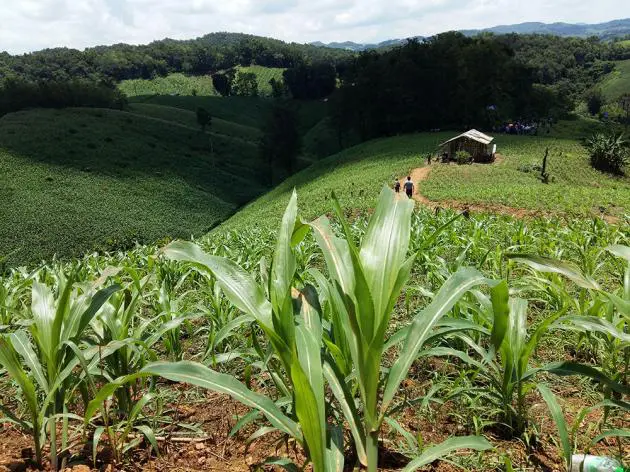
His initiative was unveiled here late last month, securing assistance from Charoen Pokphand Group (CP), which is committed to helping turn 300 rai (48 hectares) of encroached-upon forest land in the province into bamboo forest and assisting farmers to maintain their income without further encroachment.
“The size of this pilot project is small, but it is a significant step to prove that this initiative can be successful for a long-term result. This can be replicated elsewhere with cooperation from multiple parties,” he said.
“Reforestation [in itself] is not difficult. What’s difficult is that there is no forest to be reforested,” he added.
The 300 rai of forest land has been voluntarily returned by 32 households in Nan’s Phu Phiang district.
The district’s forested area has dwindled 39 per cent in the past 26 years, from 29,486 rai to 17,975 rai.
The situation throughout the province is equally grave, as the forested area declined 23 per cent from 6.5 million rai in 1964 to 5 million in 2013.
Nan is a key watershed area, contributing 40 per cent of water to the Chao Phraya River, which is dubbed the main artery of Thailand.
Government estimates indicate that Thailand’s forest cover fell from 53.3 per cent of the total land area (171 million rai) in 1961 to just 25 per cent in 1999 (80.6 million rai).
The 2004 figure showed an increase to 32.66 per cent (105 million rai), due mainly to satellite surveying without confirmation by on-the-ground survey work.
According to the UN Food and Agriculture Organisation, the total area reforested between 1906 and 2004 was about 6 million rai.
After a logging ban in 1989, encroachment for agriculture played a big part in the status of the country’s forested area.
While Banthoon welcomes the Cabinet’s recent resolution to find ways to preserve the watersheds in Chiang Mai and Nan, following the policy to crack down on encroachment, he asserts that the next step is how to reclaim encroached-upon forest land.
In his view, forests are encroached upon for a number of reasons, but in Nan – where 85 per cent of the land is classified as reserved forest – agriculture is the main reason.
This has made it impossible to force eviction, as the farmers still need land to support themselves financially. Forced eviction would only lead to resentment towards the authorities, while the cause of encroachment remained, he said.
He has called for synergy of power from the government, the military, community religious leaders, the private sector and local communities.
While the government needs to come up with a national conservation plan, the military must lend its support, he said.
Religious leaders, meanwhile, need to stir conservation awareness, while the private sector needs to assist in order to sow support from local communities.
To him, the private sector can play a key role in accomplishing micro-conservation programmes.
“I have talked to many communities in the province, and all of them say they are ready to return the encroached-upon land. They would do so if they could survive,” he said.
Under the pilot project, CP is committed to helping the 32 Phu Phiang households maintain their income. The company will work out the right model with a local conservation network.
“We’re in the supply chain,” said Suphachai Chearavanont, executive director of CP, when asked why the agricultural conglomerate had joined the project.
Talk is rife as to whether the farmers should switch from growing maize to other crops that generate better income, as their cultivation area shrinks. In high-altitude areas, coffee is a possible choice, but it takes five years for the first harvest and these farmers need support while they are waiting.
According to Banthoon, private companies can step in by providing seeds of new crops. They can also help by training on the making of new products, sharing knowledge on packaging for the locals’ agricultural products, marketing the products to reduce fees handed over to middlemen, or financing the construction of small ponds.
Supplementary careers
Kingdao Nongkha, a member of the network, said trials had begun on supplementary careers which cover chicken and pig breeding, rice plantation, and other agricultural activities. The cost and benefit of each is being considered.
For example, if they are to grow rice, should it be organic or non-organic? Pig breeding is also costly, as a pig needs seven sacks of animal feed at a cost of Bt3,500-Bt3,700 apiece to ensure that it achieves the right weight.
Then, farmers need to take into account the selling price, which is something they cannot control, she explained.
For now, they spend about Bt4,000 per rai to grow maize on the encroached-upon land. The maize needs only natural rainwater, and the output is supplied to animal-feed mills.
“None of the encroachers want to do this, but they need the money. In one family, the leader has turned 50 and no longer wants to walk up and down the hills. Yet, he needs money to finance his daughter’s college tuition fees,” Kingdao said.
Banthoon said the pilot project would shed light on the cost that participating private companies would shoulder, while adjustments could be made along the way to make the project feasible and sustainable.
Once a clear model is available, he is ready to share it with the captains of listed companies, who can incorporate this type of assistance into their CSR strategies. “Pressure must also be targeted at the government, even after the junta’s time in power ends. This must be a trend that cannot be stopped. Like democracy, once the seed is grown, nothing can stop it,” said the banker.
