
Vineyard owner extols virtues of working with farm institute
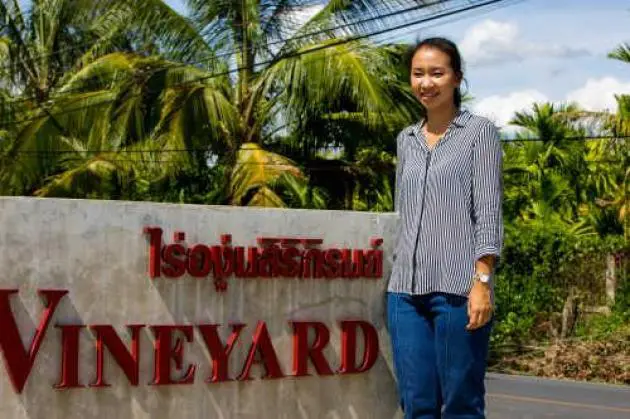


FARMERS who research and develop what to grow in collaboration with a university agricultural institute can generate returns that cover their costs and also make a profit, and therefore not need government support, says Piyatida Kootrakool, the founder an
Piyatida, 33, who graduated with a master’s in economics from Chiang Mai University and later resigned from her position at Kasikornbank to be a full-time farmer in April 2013, started to get centrally involved in her family’s 30-rai (4.8-hectare) farm in Chiang Mai after a sharp drop in mango prices in 2012.
She said her grandparents had begun the family farming business, which was then continued by her mother and father. Her parents were originally public servants, who went into farming after their retirement.
“We had grown mango for more than 20 years but then, about five years ago, the price began to drop to the point that we showed a loss. I had to join the family business and find a way to survive this problem,” she explained.
In fact a little earlier, in 2011, she had started to study which crops would be best suited for cultivation on the family land, and also those for which demand was more sustainable than for community produce, such as rice, rubber and longan.
“Grapes are suited to our land, and they also have sales potential as both fresh fruit and for making products such as jam, juice and wine. As a result, I started to learn how to grow grapes by asking for advice from the agriculture faculty at Mae Jo University in Chiang Mai, where I had got my bachelor’s degree in economics,” she said.
In 2012, she began to test-grow grapes on 1 rai of the family’s farming area, and the following year the fruit crop was able to generate income of Bt100,000 and net profit of about Bt10,000 based on sales at Bt350 per kilogram – higher than the market price of other grapes at the time.
She then decided to resign from her post at KBank, where she had worked for nine years, to expand the farm business.
Piyatida decided to grow a mix of four plants on the 30-rai plot: rice, longan, mango and grape.
“We believed that as agriculture business always faced risk from the country’s diverse weather, and there were also market fluctuations from the world market, we should balance our portfolio to grow a mix of plants to create sustainable business for the long term,” she said.
She increased the land set aside to grow grapes from 1 rai to 5 rai last year, and this will be expanded further to 8 rai next year.
Her Siriphirom Vineyard is also open to eco-tourists, who can buy grape products such as juice and jam when they visit.
Currently, her farm generates annual revenue of Bt4 million, up to 60 per cent of which is net profit.
“The key to our success in generating net profit from agriculture business is research and development of the plants, which have to be premium-grade to serve demand in the market. We have had to learn what the customers want, and what is suited to our land.
“Collaborating with the agricultural institute is necessary in order to develop products that are different from others in the market. This will help us to be sustainable farmers for the long term, without the need for government support,” said the vineyard owner.
