
DTAC expects to launch 4G-1,800 broadband soon
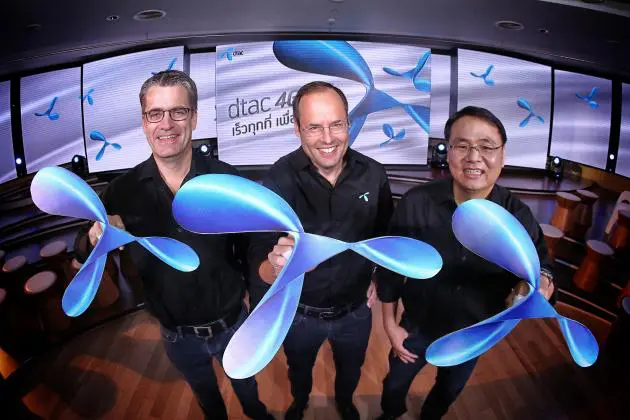


Total Access Communication (DTAC) will launch fourth-generation wireless broadband service on 10 megahertz of its 1,800MHz frequency soon, pending formal approval from relevant state agencies to utilise the band to provide the 4G service.
DTAC expects to obtain formal approval early next month, said Lars Norling, the company’s chief executive officer. The launch will cater to its subscribers’ growing demand for wireless data usage.
Prathet Tankuranun, DTAC’s chief technology officer, said the company aimed to set up 2,000 4G-1,800MHz base stations of in Bangkok in the first phase.
DTAC’s subsidiary, DTAC TriNet, currently provides 4G service on 5MHz of the 15MHz it holds on the 2.1-gigahertz spectrum under a licence from the National Broadcasting and Telecommunications Commission.
The NBTC’s telecom committee has approved DTAC’s request to upgrade its bandwidth on 1,800MHz to provide 4G service. It will forward the permit to CAT Telecom, which owns the DTAC concession and will give the formal permit to DTAC.

CAT granted the concession to DTAC to use 50MHz of 1,800MHz to offer conventional cellular services, of which the first 25MHz is being used. DTAC will use 10MHz of this 25MHz to provide 4G service, starting from Bangkok.
Norling said the 4G service on both 1,800MHz and 2.1GHz would make DTAC the fastest 4G provider. DTAC is willing to invest on 4G under the concession to serve consumer demand.
DTAC also currently provides 3G on its 2.1GHz and 850MHz spectrum bands.
He said that despite the plan to launch 4G on 1,800MHz, DTAC would also enter bids for licences on the 1,800MHz and 900MHz spectra, auctions for which are scheduled to be held by the NBTC this year. The plan is to acquire additional bandwidth to serve demand for mobile data usage better. It is also part of its preparation for the end of the concession in 2018.
According to Prathet, DTAC currently has 1.6 million subscribers to its 4G-2.1GHz service, while its target is 2.5 million by the end of this year.
DTAC also aims to increase the number of its 3G and 4G base stations nationwide to about 32,000 sites early next year from around 17,000 sites as of early this year, he added. DTAC’s existing 3G network already covers almost 90 per cent of the population.
DTAC set aside a budget of Bt20 billion for the overall network roll-out this year. That figure includes the planned 4G-1,800MHz service and the ongoing spending of Bt500 million on the network analytics solution to analyse consumer behaviour to ensure the best customer experience on the DTAC network.
As of the second quarter, DTAC had 26.9 million subscribers, 23.5 million of whom were on its 2.1GHz service.
