
Turnover growth connected to innovation


In 2005, General Electric launched "ecomagination" as a new growth strategy. At a cost of US$15 billion (Bt536.5 billion), it was designed to enhance resource productivity and reduce environmental impacts on a global scale. Over the past 10 years, it ge
Suffering from a spill, Dow Chemical was determined to generate 10 per cent of revenue from sustainably-advantaged sales. This year, sales from the products have been rising to 22.4 per cent.
"The business grew much faster than they anticipated," Benjamin McCarron, the founder and managing director of Singapore-based Asia Research and Engagement and a consultant to the Asian Corporate Governance Association, said last week.
At the Stock Exchange of Thailand’s seminar on ESG (environment, social and governance) and business, he shared the success stories of companies that embraced sustainability principles with Thai companies.
His message was that there was a connection between turnover growth and innovation – something that would ensure corporate longevity.
"If we understand that this is about better turnover growth, better risk management, operational saving and productivity, the whole question of ‘Should we do sustainability and is that a cost?’ – that question should go away.
"Sustainability will help you understand the connection of customers and innovation," he said.
The SET seminar, entitled "How Does ESG Disclosure Add Value to Business?", was told that studies showed links between ESG (environment, social and governance), operating results and earnings.
All companies should embrace sustainable business principles.
Most companies adopt philanthropy, giving after they make profits, but corporate sustainability concerns companies that help others while making money.
Good practices should be included in business operations. For example, in factories, there are measures to save water and energy. Companies should also look at the supply chain to see if suppliers use child or slave labour.
"Corporate sustainability is about managing all of those impacts, but sustainable business is another level. It looks at the lifecycle of products and services and beyond that," he said.
Companies with sustainable business principles are committed to reducing the impacts on people and moving their business towards lower impacts on the environment and society.
Unilever was one example. In the first report of its kind on human rights released in June, the consumer product company showed how it embraced sustainability practices in the supply chain.
At its facility in Kenya where sexual harassment of the workforce was reported, the company organised weekly meetings and reached out to community leaders for help.
The initiative helped make those people understand more about the unacceptable behaviour.
McCarron, an ex-fund manager, said that if women workers are better protected, better employee engagement is assured and this leads to higher productivity.
More institutional investors have also shown greater interest in companies that adopt sustainability practices. With the help of ESG analysts, they single out companies that operate in undesirable industries – mostly weapons, tobacco and alcohol.
Some funds look to engage with some good companies, trying to help them improve the whole set of standards. Companies doing poorly in these regards tend to witness pressure on their stock prices.
"Corporate sustainability and reporting help by identifying your growth area, risk management and costs and savings. It helps motivate staff and it can attract longer-term investors," he said.
As Thai companies have shown more interest in embracing sustainability practices, they should first focus on the biggest challenges – energy (where it comes from), |climate change (impacts from rainwater), human rights and corruption.
Believing that ESG is the key to driving sustainable growth for listed companies, the Thai exchange is launching Thailand Sustainability Investment (THSI). In the first year, 100 listed companies have applied to win THIS certificates, to share their stories with environmentally- and socially-concerned investors. The first-year list of certified companies will be available on October 15.
"This is the global trend for companies to achieve sustainable growth with concerns about the environment, society and governance," said
Bordin Unakul, executive vice president of the SET.
THSI is intended to be the local version of RobecoSAM’s Dow Jones Sustainability Indices (DJSI). It is modelled after DJSI, but with some details that fit Thailand’s environmental and social conditions.
The 14 companies included in the DJSI will automatically win THSI certificates. They are PTT, PTT Exploration and Production, PTT Global Chemical, Siam Cement, Advanced Info Service, Airports of Thailand, Banpu, Charoen Pokphand Foods, Central Pattana, IRPC, Minor International, Thai Oil and Thai Union Frozen Products.
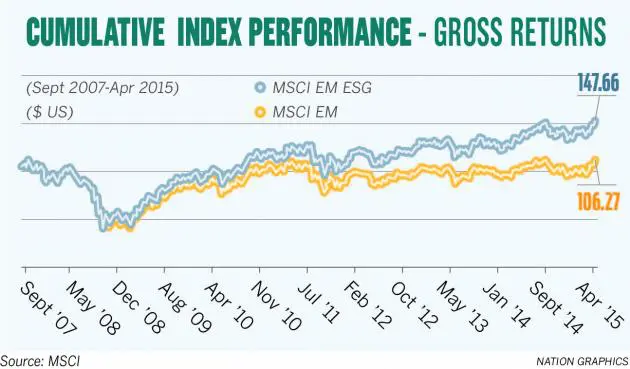
Driving the exchange towards this project is research that links better returns to sustainability practices. For instance, MSCI research (2007-15) shows that among the stocks included in the Dow Jones Industrial Average, those focusing on ESG got better gross returns than those without a ESG focus.
"Corporate social responsibility is not a fashion, but the key driver of business growth," he said.
Through THSI, the exchange also hopes to better support from investors for responsible companies. A few fund companies recently launched funds to invest specifically in companies with a ESG focus. "We believe this is a good way to drive listed companies towards sustainable and long-term growth," he said.
