
KTB turns focus to closing the gap on its competitors
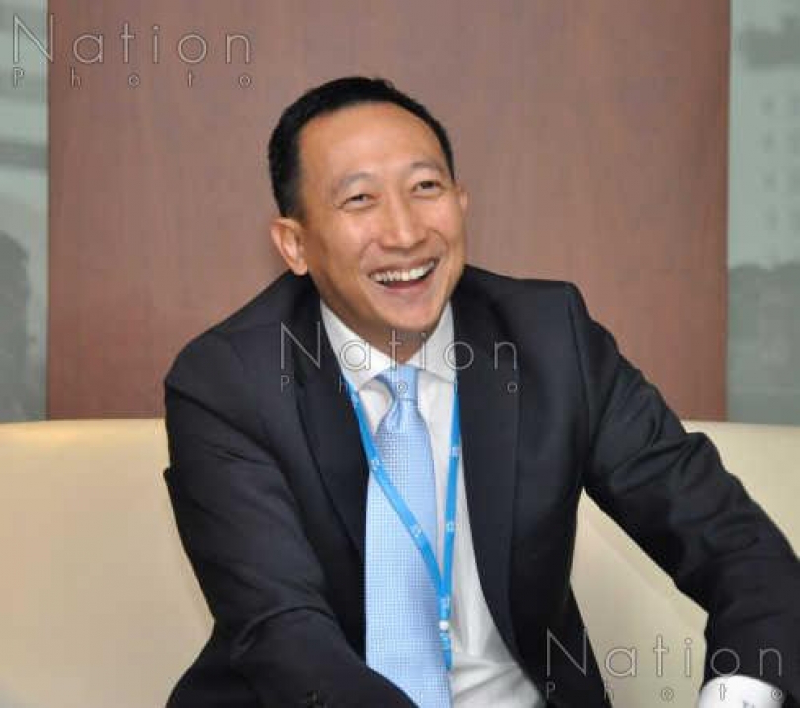


THIS YEAR is the beginning of Krungthai Bank’s attempt to scale its second ‘summit’, under which the focus will be on closing the gap on its rivals amid the challenge of a slower-growth economy and it being one of 12 state enterprises supervised by Super
In an exclusive interview with The Nation, KTB president Vorapak Tanyawong recently talked about how to ride these challenges, with digital banking being one of the key strategies for the bank’s profitability.
Vorapak has run the state-owned bank since November 2012, when he took over from Apisak Tantivorawong, who now serves as finance minister.
He said from 2016-2018, KTB must close four gaps on its rivals after ensuring a strong foundation during the institution’s first ‘summit’ period, which ended last year.
Under KTB’s seven-year plan (2015-2021), the first summit was the foundation, the second is closing the gap on its rivals, and the third is making the bank ‘the best place to work’.
For Vorapak, the gaps that KTB needs to close are net interest margin (NIM), non-interest income, cost-income ratio and risk management.
The bank’s NIM should be 3-3.5 per cent, similar to other banks that also have exposure in the retail (individual customer) and SME (small and medium-sized enterprise) segments.
He said its cost-income ratio should be below 2 per cent, similar to Kasikornbank (KBank), which now has the lowest ratio among the major banks, at 1.8 per cent.
Non-interest income, meanwhile, should sustain double-digit growth, mainly from cross-selling products, he added.
A healthy NIM means offering high-yield products to retail customers and SME clients, but those segments also pose the highest risk, therefore the bank’s debt-collection system has to be improved to comply with the challenges inherent in these areas of credit extension, he explained.
Brand marketing and alternative channels such as digital are also ways to achieve a healthy margin, the bank president said.
Customer relationship management and data analytics will be the backbone for digital banking, he said, adding that digital is changing the way of doing business very quickly, with organisations that use it as a channel having to design digital business that is more dynamic, while the digital channel must also be “sexy” if it is to attract users.
He cited the examples of Airbnb and Uber, with the latter in particular able to win over customers because of data analytics.
KTB will go the same way once it has completed its e-payment mission, and will use an outsourcing company to help data analytics make its digital banking more dynamic, he said.
Online travel and accommodation company Agoda uses outsourcing as well, with its website and feature design being created by a Thai who lives in Chiang Mai, he said.
Vorapak said that while he realised that KTB’s earnings and loan-portfolio size would not reach those of the Kingdom’s leading institutions, the bank’s net new growth would have to exceed that of its competitors.
“KBank is the leader in the SME segment with total outstanding loans of more than Bt500 billion, but it is not easy for KTB to have an SME loan portfolio as large as KBank’s. We should, however, be determined [to beat them] in terms of net new growth,” he said.
In the wider context, the slower pace of the Thai economy and rising bad debt in the banking industry last year did not support the kind of lending growth that the public has been used to seeing in the past few years, the president said.
“We currently just [largely] make income from offering cross-selling to those existing customers who are not yet using KTB’s non-lending services. That is sufficient for supporting our growth, despite the economic slowdown,” he said.
Vorapak believes that under supervision by the government’s Super Holding Co, KTB will be more flexible and able to unlock some of the barriers to greater competitiveness.
Super Holding Co will focus on corporate governance, board appointments and business operations to ensure that the first 12 state enterprises under its wing are more efficient, transparent and free from political intervention.
He recommends that the overarching entity should act as a central facilitator to make state enterprises stronger before transferring them to their original supervisors.
