
BOT welcomes fintech despite risks
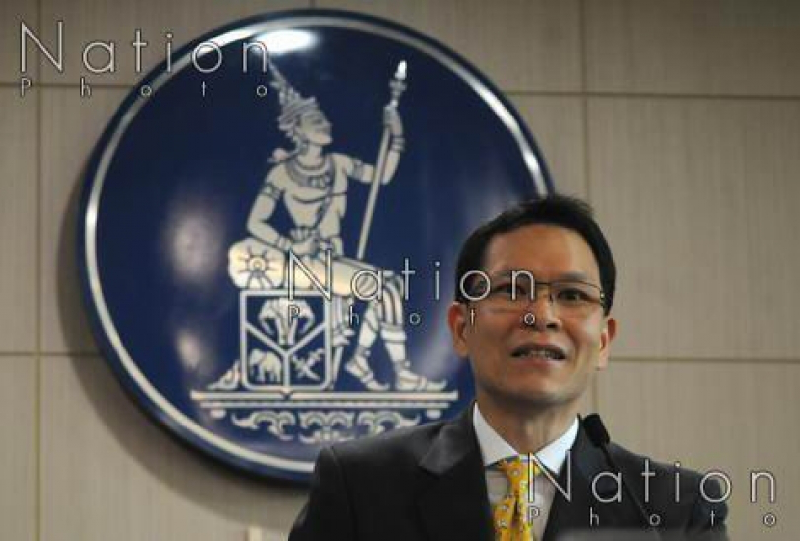


THE BANK of Thailand is extending a warm welcome to new financial technology (fintec) despite the risks associated with more electronic financial transactions.
In an exclusive interview, BOT Governor Veerathai Santiprabhob said “fintech sandbox” regulations would be ready next month, while the provision and use of new e-financial services would increasingly prevail around the country.
The central bank’s regulations on the fintech sandbox will be completed early in September as the Kingdom readies itself for more electronic services, he said.
“This is a gesture that we welcome the new technology,” he said, adding, “We see that if the technology can reach the mass public, like payments-related systems, it will benefit the country.”
National ITMX, which handles interbank transactions, now caters to 3.9 million transactions daily, valued at about Bt29 billion.
The BOT’s Financial Institu-tions Policy Committee recently endorsed the regulations, and consultative papers will be released soon to sound out industry opinion.
In the sandbox, under the universal regulations, financial and non-financial institutions are allowed to experiment with their fintech in a contained environment, within a specified period of say six to 12 months.
The experimental period will also update the regulator on the technology and allow for adjustment of the rules accordingly, Veerathai explained.
He hinted that the central bank was likely to give the go-ahead to new fintech, even though some of it may contain some risks.
He said that even if a particular technology showed some associated risk to users, it could still be applicable to a certain type of investor, but not to the general public.
“The issue now is not financial literacy, but financial-technology literacy. If a technology is applicable to investors at the top of the pyramid, it could be offered to them only. If it is to be offered to the general public, all loopholes must be plugged first,” he stressed.
Electronic crime
Despite reports of unfortunate incidents concerning e-services, the governor said such occurrences should not deter new development.
That said, it is important that all parties raise their guard against possible risks, he said.
Consumers in general are urged to defend themselves, and the nature of that defence evolves over time, he added.
In the past, when ATM cards were first in use, users were told not to attach PIN codes to the cards. Now, when modern-day transactions are made via electronic devices, they should not transmit important data while using public Wi-Fi networks, Veerathai said.
Meanwhile, although maximum e-transaction amounts are generally set at a high level, users can tell their banks to limit the amounts for their accounts.
Both financial and non-financial institutions should also play their part in improving financial-technology literacy, he said.
Among financial institutions, internal control is of great importance, in order to close any loopholes.
The BOT and the National Broadcasting and Telecom-munications Commission – the telecom regulator – are also now working closely following a reported theft through a mobile banking account, he said, adding that the identification process may need to be stepped up, as the use of the one-time password (OTP) system may prove inadequate.
Further cooperation is also foreseeable, as the national PromptPay service will be online soon.
Regarding the recent malware attack experienced by the Government Savings Bank, the central bank chief said it was the first case of its kind in the world, and the GSB had been quick to alert all other banks to the threat.
“We can’t prevent malware, as new forms emerge every day. It’s more important to detect irregularities as soon as possible and have efficient news report dissemination. These are new [but] manageable risks,” he explained.
As Thailand enters the digital age, non-financial institutions need personnel knowledgeable in cyber-security, he said.
“This is also crucial among financial institutions. If their personnel do not understand a new technology, this could lead the financial system towards vulnerability,” he warned.
