
New US trade policy ‘cause for concern’
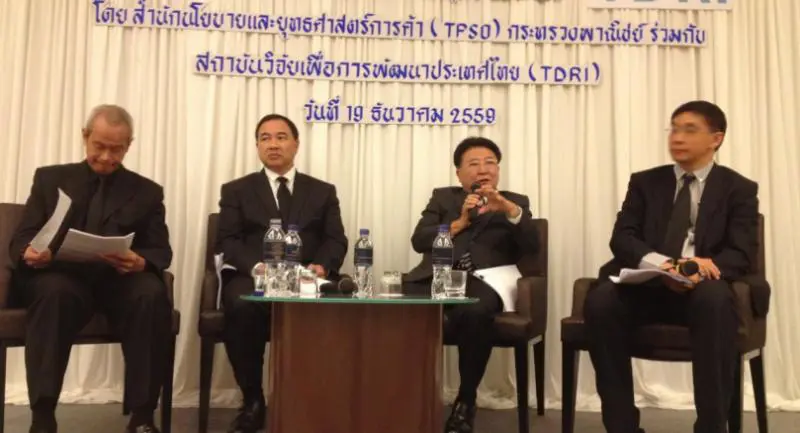


THAILAND AFFECTED BY DIFFERING CHINESE, US APPROACHES, SEMINAR TOLD
THAILAND’S policymakers need to raise concerns about international trade after the confrontation of the two economic superpowers, China and the US, which will spawn gigantic global changes and redraw the commercial landscape, a seminar heard yesterday.
The United States’ international trade policy, under its new president Donald Trump, will be in line with the idea of protectionism and the abandonment of the country’s participation in international trade agreements, such as the Trans-Pacific Partnership, to focus on bilateral negotiations and agreements made with certain countries, said Nopporn Thepsittha, chairman of the Thai National Shippers’ Council.
“US moves will have a significant impact on China, which is trying to be a leader in free trade and regional economic forums, such as Asia-Pacific Economic Cooperation,” he said.
“China has applied a diversified strategy by dispersing its production facilities outside the Kingdom … to many potential countries, especially in Asean,” he told the forum on Asean and Thailand’s business opportunities hosted by the Commerce Ministry’s Trade Policy and Strategy Office and the Thailand Development Research Institute (TDRI).
Next year will be one of crisis for local businesses and exporters in Thailand, he said.
“The issue is how Thai businessmen will have strong resistance against the invasion of China into Thailand and other potential markets in Asean, especially the CLMV countries [Cambodia, Laos, Myanmar and Vietnam], as well as new frontier countries like South Africa.
Thai base for Chinese firms
“Chinese firms have strong capability in copying and manufacturing products from low to high quality. They can use Thailand as a place of production and export products to many surrounding markets,” he said.
Somyos Tungmelarb, vice president of the Federation of Thai Industries, said Thailand’s roots in manufacturing and technology came from Japan. This country can make quality products that are recognised and accepted in the region, particularly the CLMV countries.
“What we [manufacturers] are lacking is the ability to innovate new products and manufacturing know-how. We are still relying on importing machines from abroad.
“Now many surrounding countries can manufacture similar |products.
“Many international brands, such as in clothing and garments, have shifted their production from Thailand to other labour-intensive countries,” he said.
Kalin Sarasin, vice chairman of the Thai Chamber of Commerce and chairman of the Tourism Authority of Thailand, said that the government, policymakers and the private sector should follow future trends closely, which will change the trading landscape and the way of doing business.
Based on research from international consulting agency Frost & Sullivan, there are many mega-trends, including urbanisation and the shifting paradigm from green to smart, such as smart cities and smart companies.
There are also social trends such as the emergence of the “Y” and “She” economies as well as the greying of society and the proliferation of mobility and connectivity.
“Thailand is moving from a manufacturing-oriented to a service-oriented country.
In the near future, more than 50 per cent of the country’s GDP will be contributed by the service sector,” Kalin said.
TDRI president Somkiat Tangkitvanich said Thai businesses needed to enter Asean markets if they wanted double-digit annual sales growth.
“We have seen many business opportunities in Asean driven by urbanisation and the rise of many new urban areas, as well as the increase of middle classes in the region.
“They require many products, from construction materials and furniture to services and lifestyle products,” he said.
