
Big Data to steer The Mall campaigns


THE MALL GROUP has revealed that the main thrust of its marketing strategy this year will be based on the implementation of a BigData analytics system, which will allow the mall operator to develop tailor-made campaigns for individual shoppers.
The group posted a 4-per-cent increase in revenue to Bt54 billion last year, with further growth in the range of 4 per cent to 5 per cent projected for this year.
Voralak Tulaphorn, senior vice president, said the company would focus on encouraging shoppers to increase the length of time they spend at its shopping malls, using a number of key drivers: shopping convenience, greater promotions, good merchandising, strong branding and a digital strategy.
“By focusing on increasing the length of time that individual shoppers stay at our shopping malls, we will be able to create marketing campaigns and events from a wider perspective,” she said, adding that the longer a shopper spends in a mall, the more they tend to buy.
She said there were currently about 3 million M Card holders, which have been developed as the group’s database of shoppers. About 70 per cent of the card members are female.
“In the digital era of today, consumers are bombarded with information. They have a short memory [about what is being offered] and need to be reminded frequently,” Voralak said.
“Today’s shoppers also do not believe in product- or brand-owners, or even ambassadors, and friends and relatives have become their biggest shopping influencers. They are smarter and have less loyalty to any particular brand name,” she explained.
Shoppers also do not normally buy products at a single retail outlet, but visit many stores depending on their lifestyle and objectives, the senior vice president said.
A shopper might, for example, decide to shop for fashion clothing at downtown malls like Siam Paragon, which they believe are the go-to places for fashion brands, but for daily products, they choose to visit convenience stores or supermarkets near to where they live, she said.
Executive vice president Chamnarn Maytaprechakul said The Mall Group would this year rely more on consumer insight, database and customer-relationship management as strategic components in creating marketing campaigns and promotions.
He gave the example of the group’s two major shopping malls – Bluport Hua Hin and The Mall Nakhon Ratchasima – which are situated in completely different locations, have different competitors in each area and cater to different groups of shoppers, who have different lifestyles.
“We will revamp our marketing team to be more focused both by location and by particular department store and shopping mall,” he said, adding that the strategy would allow marketing people to create tailor-made campaigns and activities to certain groups of shoppers in particular locations based on consumer insight.
Chamnarn also said that Thailand’s retail sector had been more active since late last year, thanks to the government’s tax break for shoppers, which was extended to 18 days from the originally planned seven.
The group’s sales revenue grew by 40 per cent from December 21 to 25, while during the first 13 days of the tax-break period, from December 18 to 31, revenue increased by 10 per cent, he said.
Entering 2017, it is expected that higher consumer spending power will carry over to Chinese New Year at the end of this month, the executive vice president said.
Generally, overall domestic spending during Chinese New Year is no less than Bt50 billion, according to the University of the Thai Chamber of Commerce’s Centre for Economic and Business Forecasting.
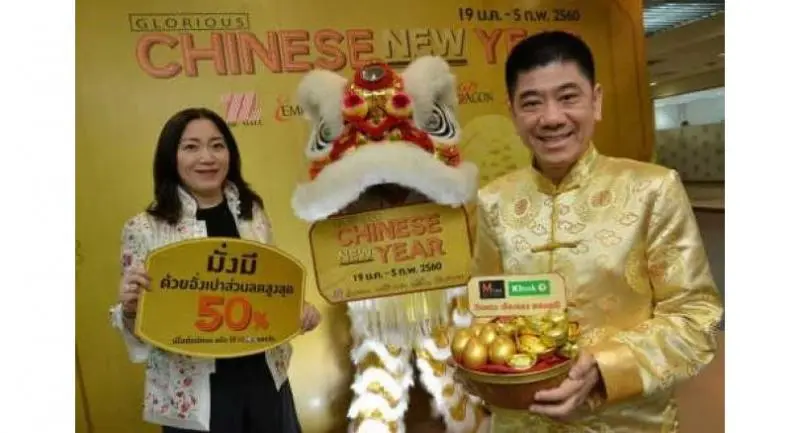
The majority spend on traditional practices such as ancestor worship, gifts, decorations, materials, food and clothing, while the new generation of Thais with Chinese heritage tends to purchase worship sets at shopping malls. With forecast spending during Chinese New Year 2017 expected to be no less than that of previous years, The Mall Group is to hold a “Glorious Chinese New Year” campaign from tomorrow through to February 5 to cater to customer needs during the celebration period, Chamnarn said.
“Chinese New Year is important to The Mall Group, and we are leaders in worship and fortune activities during Chinese New Year every year.
“This year is the year of the glorious and prosperous fire rooster, the inspiration behind this year’s ‘Glorious Chinese New Year’ concept of the ‘Wealthy and Virtuous Rooster’,” he added.
