
Reserves fall to Bt75 bn
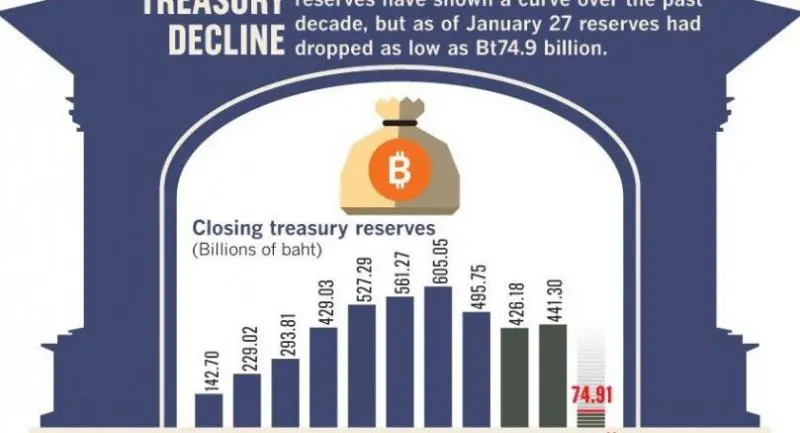


Plunge blamed on infrastructure outlays and economic stimulus moves late last year
Thailand’s relatively low Treasury reserves – Bt74.9 billion as of January 27 – has put a spotlight on the government, as it will seek to raise billions of baht from new taxes on aviation fuel and motor lubricants to cover a revenue shortfall.
However, the government is not broke, according to Finance Minister Apisak Tantiworawong, who insists that reserves of Bt50 to 100 billion are sufficient.
Apisak says the legal requirement for treasury reserves of Bt300-500 billion is too high and has caused excessive interest costs on borrowings so the ministry is studying a change to current regulations.
Prime Minister Prayut Chan-o-cha appeared upset yesterday when asked by reporters about the “low level” of Treasury reserves. He urged the public not to panic about the country’s fiscal position.
In fact, the latest figure of just under Bt75 billion is not the lowest on record for national reserves. In the first quarter of 2009, they fell to Bt52 billion during the Abhisit Vejjajiva government. However, the reserves have fallen over the past 4-5 years, with year-end totals ranging from a low of Bt170 billion in December 2014 to a high of Bt380 billion in December 2015.
Prayut said his government had spent more public money on various infrastructure and economic stimulus projects for national benefit over the next 5-10 years, causing the reserves to drop at this time of the year.
Dr Kobsak Pootrakool, vice minister of the PM's Office, said the government will get personal income tax revenues around April while corporate income tax revenues will be paid in May and August so low reserves at this time of the year were not unusual.
He also said budget disbursement for infrastructure and other projects was now faster than before so Treasury reserves had dropped more quickly.
Finance Minister Apisak said tax revenue would start flowing to the Treasury in coming months so the public did not have to worry about the relatively low opening figure for this year. The government also always has an emergency credit line of more than Bt80 billion to borrow from financial markets.
Apisak said borrowing for Treasury reserves was expensive as the interest rate was about 2 per cent per annum, costing about Bt2 billion on every Bt100 billion. The minister said the latest tax hikes on aviation fuel and motor lubricants had nothing to do with the level of reserves.
“We still have a lot of room to manage the fiscal resources and finance the budget deficits. The tax hikes are aimed at fairness since poor people pay a fuel tax of Bt3-5 per litre for bus services but rich people pay only a Bt0.20-per-litre tax on jet fuel for airline tickets,” he said.
Decharut Sukkumnoed, an economist at Kasetsart University, posted on Facebook that Treasury reserves were about Bt495 billion when the military administration took office nearly three years ago. So, the slump to Bt74.9 billion as of December 2016, prompted much criticism on social media.
Finance Ministry sources have admitted that there was a revenue shortfall of Bt56 billion at the end of last year while disbursement of the budge has been brisk, up Bt74 billion from the same period a year ago. This had caused the reserves to slump this month.
Revenue collection in the first quarter of fiscal 2017 (October to December 2016), totalled Bt553 billion while expenditure was as high as Bt969 billion, resulting in a deficit of Bt415 billion. A big portion of money was used to help farmers, to stimulate economic activity and finance long-term infrastructure projects.
Head of the Fiscal Policy Office, Krisada Chinavicharana, said earlier that a deficit budget of Bt258 billion was recorded in October 2016, the first month of fiscal 2017, as expenditure in October 2016 alone jumped by 16 per cent to Bt435 billion.
The major disbursements included a budget of Bt62.58 billion for the Department of Local Administration, Bt54 billion for the Bank for Agriculture and Agricultural Cooperatives, and a Bt45.45 billion subsidy for the Education Ministry.
