
Asia Pacific marks 3% increase in 2016 arrivals
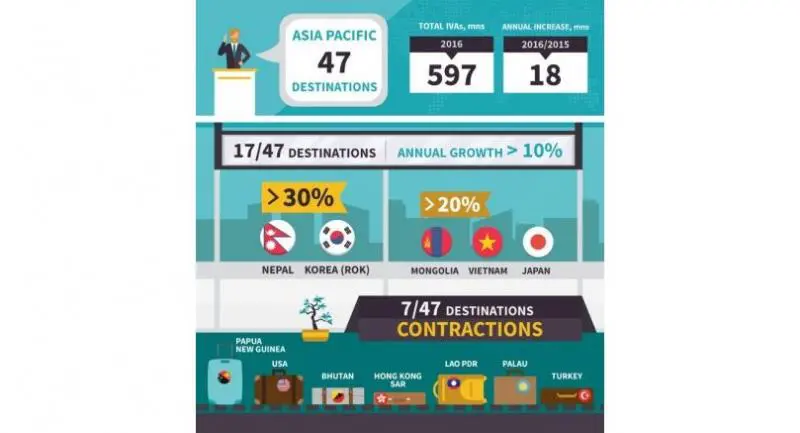


PATA has released its latest annual travel monitor report that shows an annual increase of 3 per cent in foreign arrivals into 47 Asia Pacific destinations in 2016 - an aggregate inbound count of almost 600 million.
Despite the significant challenges being faced by Turkey's tourism sector, the annual net increase in arrivals into the Asia Pacific region was still strong, adding close to 18 million additional arrivals to its total foreign inbound count year-on-year.
Seventeen of those destinations had double-digit growth rates ranging from more than 30 per cent for Nepal and South Korea and 20 per cent for Mongolia, Japan and Vietnam. Growth was once again uneven, with seven Asia Pacific reporting contractions in foreign arrivals in 2016 compared to 2015.
The strongest destination sub-regions for annual growth between 2015 and 2016 were South America, with an annual increase of 13 per cent, Oceania with a gain of 11 per cent and South Asia with 10 per cent growth.
Across the three major regions of the Asia Pacific, Asia was the frontrunner for foreign arrivals by volume with 436 million international arrivals, followed by the Americas with 147 million and the Pacific with 24.5 million..
Intra-regional travel flows were extremely strong for Asia and the Americas with 94 per cent and 78 per cent respectively of their inbound volumes arising from within the same region.
The Pacific was the only destination region to see the majority of its arrivals come from outside that region. More than 52 per cent of foreign arrivals into the Pacific in 2016 came from Asia as opposed to the Pacific which generated 32 per cent of the inbound arrivals to that region.
Origin markets in Northeast Asia were the largest generators of absolute volumes into Asia Pacific in 2016, led by China and Hong Kong, which generated 108.5 million and 93.7 million arrivals respectively.
These were supported by Macao, which generated 24.4 million arrivals and South Korea with 23.2 million, Japan with 20.3 million and Chinese Taipei with 19.8 million arrivals.
The USA, Canada and Mexico also rated in the top 10 generators of foreign arrivals in 2016, producing 45.8 million, 24.9 million and 20.3 million arrivals respectively into the Asia Pacific.
Singapore was the only Southeast Asian origin market in top 10, generating close to 19.9 million arrivals for the year.
There were some very strong annual growth increases from a number of origin markets such as Cuba (plus 52 per cent), Ukraine (plus 41 per cent) and Argentina (plus 24 per cent).
Similarly for a number of origin sub-regions, each of which added significant incremental volumes to the absolute count into Asia Pacific destination sub-regions between 2015 and 2016. Northeast Asia topped that list with an additional eight million arrivals within its own sub-region, and 4.4 million additional arrivals into Southeast Asia.
The reverse was also true, with Southeast Asia generating 2.2 million and 1.8 million additional foreign arrivals into Northeast Asia and Southeast Asia respectively while in the Americas it was North America into Central America that rated highly, adding 1.2 million additional arrivals between 2015 and 2016.
