
Japan mobilises public and private sectors to revive shipbuilding
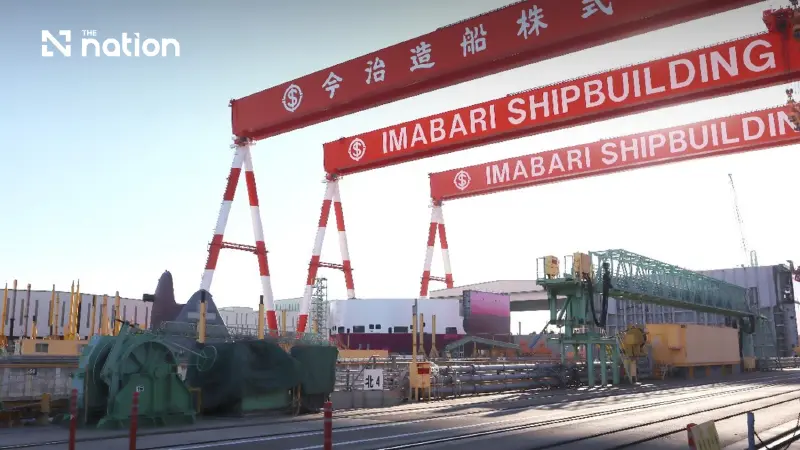


A government road map targets twice the 2024 shipbuilding volume by 2035, backed by 1 trillion yen for modern yards, cleaner vessels and skills.
- Japan is launching a public-private initiative with a combined investment of approximately 1 trillion yen to revive its shipbuilding industry, aiming to double domestic production volume by 2035.
- The strategy focuses on increasing productivity through investment in automation, robotics, and artificial intelligence, as well as developing the workforce to address labor shortages.
- A key part of the plan is to gain a competitive advantage by developing next-generation, zero-emission vessels, such as ammonia-fueled ships.
- The revival is driven by economic security concerns, as Japan relies heavily on maritime transport for essential goods and domestic demand for new ships currently exceeds national production capacity.
Japan is combining government support with private-sector investment to rebuild its weakened shipbuilding industry under a road map intended to double domestic shipbuilding volume by 2035 from its 2024 level.
Drawn up by the transport ministry in 2025, the strategy calls for about 1 trillion yen in combined public and private investment.
Its scope extends beyond new plant and equipment, with robots and artificial intelligence expected to raise productivity while workforce development strengthens the industry more broadly.
The initiative follows a prolonged decline in Japan’s global standing.
The country held close to 40% of the world shipbuilding market in the 1990s, but its share had fallen below 10% by 2024 as large-scale yards in China and South Korea expanded and Japan’s competitiveness weakened.
Demand at home already exceeds available capacity.
Domestic shipowners have orders totalling about 12 million gross tonnes when measured by vessels’ completion years, while domestic shipbuilding capacity stands at roughly 10 million gross tonnes.
With Japan relying on overseas supplies of essential goods such as energy and food, and maritime transport carrying virtually all its trade, shipbuilding is regarded as vital to economic security.
Yukito Higaki, chairman of the Shipbuilders’ Association of Japan and president of Imabari Shipbuilding Co., Ltd., warned that the country could not withstand fierce international competition unless its shipbuilding industry worked together in a united national effort.
To underpin the programme, the ministry allocated 120 billion yen from the fiscal 2025 supplementary budget to establish a shipbuilding revitalisation fund.
The money will subsidise production-facility upgrades, automation investment and research and development.
The ministry is seeking total investment of about 1 trillion yen when private contributions are included.
Part of the public and private financing will come through green transformation, or GX, economic transition bonds intended to support decarbonisation.
Funding will be directed towards core vessel types including bulk carriers, tankers and container ships, along with car carriers, a segment in which Japan retains a competitive advantage.
Liquefied carbon dioxide carriers, expected to develop into a new market, are also covered.
Within these categories, next-generation ships producing effectively no greenhouse gas emissions are viewed as especially promising, and work on vessels intended to lead the global market is already under way.
Nippon Yusen Kabushiki Kaisha, or NYK Line, and its partners aim to complete the world’s first ammonia-fuelled medium gas carrier for international shipping in November.
Shinichiro Otsubo, a distinguished project research fellow at the Japan Transport and Tourism Research Institute, said the market for next-generation ships remained limited.
However, he believed that producing exceptional vessels could change how buyers viewed Japan’s capabilities in other major ship categories.
Otsubo also identified rising steel prices and labour shortages as major obstacles.
Building a ship in Japan costs about 20% more than in China, primarily because of steel prices, with steel accounting for roughly 30% of total costs.
In response, shipbuilders, shipping companies, marine-equipment manufacturers and steelmakers have formed a high-level council to create a co-operative framework.
The body held its first meeting in March.
An increase in foreign workers has halted the overall decline in the shipbuilding workforce, although the number of Japanese employees continues to fall.
The road map proposes training highly skilled personnel through collaboration with communities around shipyards and educational institutions, alongside better employment conditions and the introduction of humanoid robots.
Shipowners also believe a stronger domestic shipbuilding base would improve the competitiveness of Japan’s maritime transport sector.
Hitoshi Nagasawa, vice-president of the Japanese Shipowners’ Association and chairman of NYK Line, said Japan, as an island nation, could not afford to lose either the people who build ships and their components or those who operate them.
Reinforcing shipbuilding, he added, was a central part of strengthening the maritime industry as a whole.

[Copyright The Jiji Press, Ltd.]
