
Anutin, Min Aung Hlaing Pledge Deeper Thai-Myanmar Trade Ties
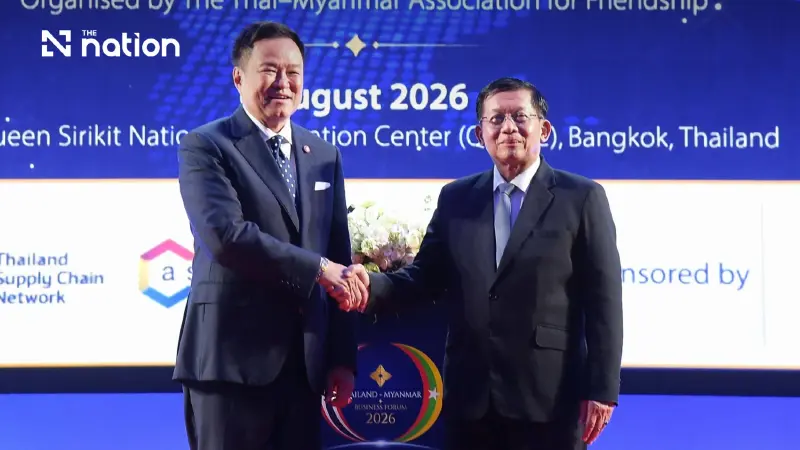


Bangkok forum sees Thai PM and Myanmar President commit to a $12bn trade target, a reopened border bridge and wider investment across energy, agriculture and healthcare
- Thailand's Prime Minister Anutin Charnvirakul and Myanmar's President Min Aung Hlaing committed to increasing bilateral trade to a target of US$12 billion, up from the current $7.4 billion.
- The leaders agreed to reopen the second Thai-Myanmar Friendship Bridge linking Mae Sot and Myawaddy and to consider opening additional border checkpoints to boost trade.
- Thailand pledged to support its businesses in expanding investments into Myanmar, with a focus on key sectors such as energy, agriculture, healthcare, and infrastructure.
- Myanmar is actively encouraging Thai investment by promoting its Special Economic Zones and a "frictionless trade ecosystem" that includes a direct Kyat-Baht currency settlement system.
Bangkok forum sees Thai PM and Myanmar President commit to a $12bn trade target, a reopened border bridge and wider investment across energy, agriculture and healthcare.
Thailand's Prime Minister Anutin Charnvirakul used a landmark business forum in the capital on Thursday to declare that economic cooperation with Myanmar would press ahead "regardless of political circumstances at home or abroad", setting a decisive tone before Myanmar President Min Aung Hlaing followed with a detailed pitch to draw Thai capital into his country's economy.
Speaking at the Thailand–Myanmar Business Forum 2026, held at the Queen Sirikit National Convention Centre and attended by more than 700 government officials and business representatives from both nations, Anutin said the government's core duty was to safeguard citizens' livelihoods, employment and income, and that a stable economy was central to that mission.
He described the private sectors of both countries as the driving force behind decades of cross-border investment, employment and opportunity.
Trade Target Raised to $12bn
Anutin noted that Myanmar is already one of Thailand's most significant economic partners, with bilateral trade currently worth more than US$7.4 billion and considerable room to grow. Thai investment in Myanmar spans energy, manufacturing, transport, logistics, telecommunications, property and tourism.
Both leaders welcomed the reopening of the second Thai-Myanmar Friendship Bridge linking Mae Sot and Myawaddy and agreed to resolve regulatory obstacles so the crossing can operate at full capacity as quickly as possible.
Thailand will also consider opening additional border checkpoints where conditions allow to support border trade and local economies.
Anutin confirmed Thailand will host a joint trade commission meeting between the two countries' commerce ministers, aimed at pushing bilateral trade to US$12 billion and reviving border trade activity before the end of the year.
He said Thai businesses retain confidence in Myanmar's long-term potential and are ready to expand into energy, agriculture and agro-industry, infrastructure, tourism and future industries, with Bangkok pledging to cut red tape and streamline regulations to support that expansion.
On energy, the two sides agreed to continue existing cooperative projects and accelerate related processes, while a new joint working group will be formed to advance transport and logistics connectivity and align related regulations.
Anutin argued that in a period of global supply-chain realignment, nations able to connect people, trade and investment efficiently would be first to benefit — a role he said Thailand and Myanmar could fulfil together, with the private sector as the primary engine of growth.
Myanmar's Pitch: A Land Bridge Between Two Oceans
President Min Aung Hlaing responded with an extensive account of Myanmar's economic ambitions, framing the relationship as one of the region's oldest, tracing formal ties back to 1948 and describing the bond between the two nations in familial terms.
He said Myanmar business owners favour partnership with Thailand and expressed confidence that firm government policy frameworks would further strengthen private-sector links, inviting Thai investors to help build an economic corridor that lets each country's strengths fill the other's needs.
According to his prepared remarks, Myanmar recorded bilateral trade with Thailand of over US$4 billion in the 2025–2026 period, with natural gas, agricultural products, marine goods and garments among its main exports northward.
He pointed to accumulated Thai investment in Myanmar of roughly US$6 billion across some 13 major projects, concentrated in energy, agriculture and manufactured goods, and cited Thailand's continued position among Myanmar's largest foreign investors.
Presentation materials accompanying the address positioned Myanmar as a geo-strategic "land bridge" directly connecting East Asia, Southeast Asia and South Asia and as a maritime link between the Pacific and Indian Oceans.
Three Special Economic Zones were highlighted as investment gateways: Thilawa, near Yangon, offering ready industrial infrastructure; Kyaukphyu, in Rakhine State, serving as an Indian Ocean deep-sea port and a hub of the China-Myanmar Economic Corridor; and Dawei, in Tanintharyi Region, pitched as the nearest and fastest deep-sea export route from Thailand to South and West Asia.
Investment Matrix and Healthcare Cooperation
Investors were invited into three broad sectors: resources and agriculture, including livestock, agro-processing, fertilisers, cement, gas and mining; industrial infrastructure, spanning renewable energy, construction and manufacturing; and services and technology, covering digital services, education, health, transport and tourism.
Healthcare emerged as a specific area of focus, with Myanmar seeking to pair its rising demand for medical services with Thailand's advanced expertise through pharmaceutical and medical device manufacturing, construction of modern hospitals, and joint development of a higher-quality public healthcare system.
To reassure investors, officials outlined what was described as a "frictionless trade ecosystem" built on four pillars: a direct Kyat-Baht settlement system running since 2022 to speed the flow of goods; full implementation since 2024 of four intellectual property laws protecting domestic production and investment; tax reforms including incentives for electric vehicles and related industries; and continued protection under the Myanmar-Thailand investment promotion and protection agreement in force since 2012.
On the digital front, Myanmar promoted a roughly 10,000-acre "Cyber City" project in a temperate highland area near Pyin Oo Lwin, alongside a national Digital Roadmap to 2030 and continued simplification of regulatory processes to support micro, small and medium enterprises, which officials described as the backbone of both economies.
Both sides also raised concerns over illegal cross-border trade, calling on local communities and business operators to help curb smuggling and the entry of substandard or unsafe food and medicine, warning of the toll such activity takes on state revenues and consumer safety in both countries.
A 'Win-Win' Close
President Min Aung Hlaing closed by casting the partnership as complementary: Myanmar's abundant workforce, natural resources, strategic location and market scale set against Thailand's technology, capital and international management experience — a combination, he said, capable of building a stronger, more sustainable economic ecosystem for both nations.
Anutin, for his part, described the forum as more than a talking shop, calling it the starting point of a shared transformation the public and private sectors of both countries would build together, and thanked the Thai-Myanmar Friendship Association and Myanmar's chamber federation for organising the event.
