
Thailand, US Vow Deeper Trade Ties Despite Tariff Doubts
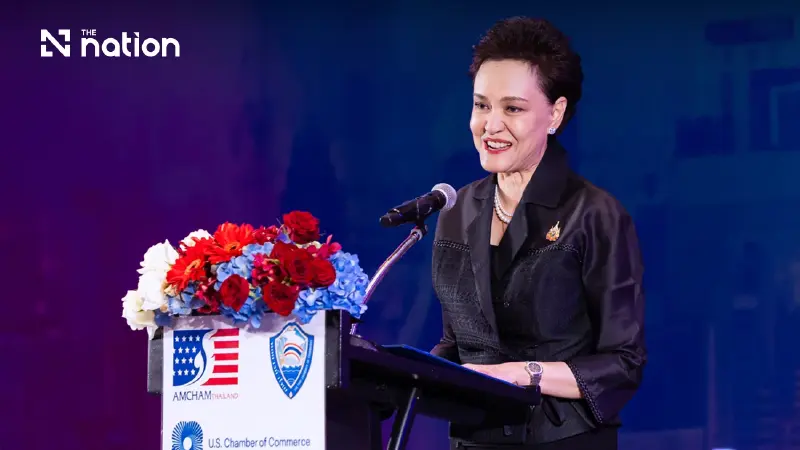


At Bangkok's 2026 summit, Thai and US leaders pledged closer trade, energy and AI cooperation even as tariff uncertainty clouds the outlook
- At a summit in Bangkok, officials from Thailand and the U.S. pledged to deepen their economic partnership, aiming for a new trade deal and increased cooperation in energy and AI.
- This commitment is challenged by significant tariff uncertainty, which officials from both sides acknowledged is a major concern that negatively impacts business decisions.
- Despite a recent surge in bilateral trade, an official noted that Thailand remains under U.S. investigation for issues like excess manufacturing capacity and transshipment, which could lead to future tariff actions.
At Bangkok's 2026 summit, Thai and US leaders pledged closer trade, energy and AI cooperation even as tariff uncertainty clouds the outlook.
Senior Thai and American officials used the third annual Thailand-US Trade and Investment Summit in Bangkok on Monday to press for closer economic ties and a swift conclusion to a bilateral trade deal, even as they acknowledged that tariff uncertainty continues to weigh on business decisions in both countries.
Deputy Prime Minister and Commerce Minister Suphajee Suthumpun, delivering the keynote address on behalf of Prime Minister Anutin, told delegates that Thailand was determined not merely to respond to shifting global trade patterns and geopolitical uncertainty but to position itself as "a resilient, secure and trusted manufacturing and supply chain base for the region and the world".
The United States remains Thailand's most important trading partner and largest export market, she said, noting that hundreds of American firms operating in the country had made cumulative investments worth tens of billions of US dollars, supporting hundreds of thousands of jobs and driving technology transfer.
Thai companies have reciprocated with more than US$19 billion invested in the United States, a figure she said would grow this year, generating tens of thousands of American jobs in return.
Suphajee said Thailand was undergoing a transformation towards a high-income economy anchored in advanced technology and was courting investment in digital technology, artificial intelligence, robotics, automation, semiconductors, clean energy, biotechnology and next-generation mobility.

On trade, she said Bangkok was working to conclude a framework agreement on reciprocal trade with Washington that would expand two-way commerce, including greater Thai imports of American energy, machinery and selected agricultural products where domestic supply falls short.
She confirmed she would travel to Washington for a third time this year in pursuit of a balanced, mutually beneficial outcome.

Washington's view: a relationship "worth strengthening"
In recorded remarks, Michael DeSombre, US Assistant Secretary of State for East Asian and Pacific Affairs and a former US ambassador to Thailand, described the alliance as delivering "real benefits" for both peoples across security, diplomacy and economics.
He pointed to bilateral trade growth from US$23 billion in 2000 to US$111 billion in 2025, noting Thailand is now Washington's second-largest trading partner in Southeast Asia — but also the source of its second-largest trade deficit in the region.
DeSombre said the two governments hoped to conclude an agreement on "reciprocal, fair and balanced trade" that would improve market access and address customs enforcement, intellectual property protection and regulatory practices.
He highlighted recent energy cooperation, including a gas supply deal involving PTT Public Company that will deliver roughly one million tonnes of gas annually for two decades, a civil nuclear cooperation agreement signed last year, and an October memorandum on critical mineral supply chains.
On technology, he said Washington wanted to support Thailand's ambition to become a regional artificial intelligence hub by 2027 through a new US-ASEAN AI initiative offering financial and technical support for governments deploying American AI systems and urged Thailand to rely on "trusted suppliers" for 5G, 6G, undersea cables and data centres.

O'Neil: a 250th birthday and a call to rebalance
US Ambassador to Thailand Sean O'Neil used his address to invite guests to a series of "American Fairs" being held in Hat Yai, Nakhon Ratchasima, Chiang Mai and Bangkok in September and October to mark the 250th anniversary of American independence.
He traced the two nations' ties back to an 1818 voyage by an American sea captain up the Chao Phraya River, which led to the 1833 Treaty of Amity and Commerce — traditionally cited as the start of US-Thai relations, though O'Neil argued the friendship in practice stretches back "over 200 years".
O'Neil said US President Donald Trump had worked since taking office to ensure trade relationships benefit American workers, arguing that "large and persistent trade imbalances are not sustainable or healthy" for either side.
Restoring balance, he said, would give consumers more choice, open the US market further to Thai investors, and unlock opportunities in energy and new technology for both countries.

Goyer: tariffs have not derailed trade, but uncertainty carries a cost
Closing the morning session, John Goyer, Vice President for Southeast Asia and Oceania at the US Chamber of Commerce, offered a data-driven assessment of how US tariff policy has affected bilateral trade so far this year.
Citing US figures, he said American imports from Thailand jumped 72 percent in the first six months of 2026 — the sharpest increase in trade data stretching back to 1990 — while US exports to Thailand rose 30 percent over the same period, albeit from a smaller base.
Goyer noted that Thai goods initially faced a headline tariff of 19 percent under the International Emergency Economic Powers Act, though extensive exemptions meant the effective rate paid was closer to 8–10 percent.
After the US Supreme Court ruled those tariffs illegal at the end of February, a 10 percent tariff imposed under a different section of US trade law took their place, pushing the effective rate down to roughly 5.5 percent between March and June.
A subsequent US Trade Representative investigation into forced labour in supply chains lifted the headline rate to 12 percent.

He cautioned that Thailand remains one of 16 trading partners under a separate USTR investigation into manufacturing excess capacity that could result in further tariff action and noted a White House report released last week examining alleged transshipment of Chinese goods through third countries, including Thailand.
Even so, he said the tariff differential between Chinese and Thai goods had narrowed from around 32 percent last year to 16.6 percent as of June, a trend with competitive implications for Thailand.
"Wherever we end up, we need to be in a place of certainty and predictability," Goyer said, adding that continued uncertainty would ultimately come at the cost of slower economic growth.
The summit, held under the theme "Building on a Longstanding Partnership", was jointly organised by AMCHAM Thailand, the Thai Chamber of Commerce and the US Chamber of Commerce, and drew business executives, investors and government officials from both countries for a day of panel discussions covering trade, tourism, agriculture, energy, infrastructure, healthcare and the creative economy.
