
Kumamoto earthquake damage estimated at over one trillion yen
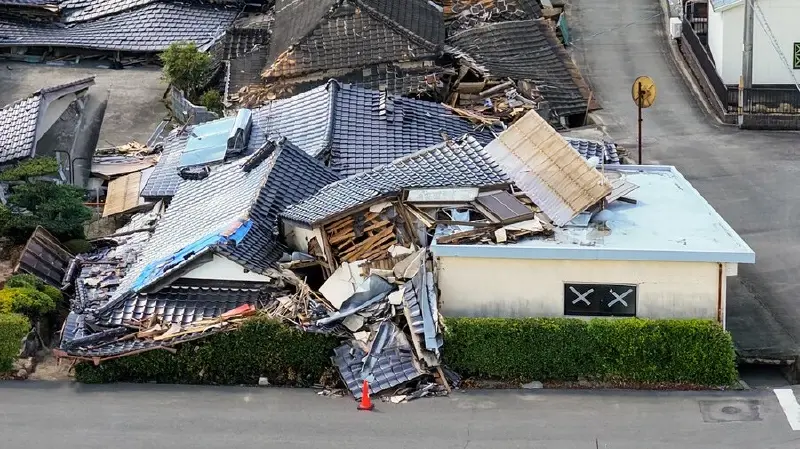


Homes accounted for most of the estimated 1,094.2 billion yen in housing and infrastructure damage from July's earthquake in southwestern Japan.
- The Japan Society of Civil Engineers estimated the total damage from the Kumamoto earthquake at 1,094.2 billion yen.
- Damage to housing accounted for the largest portion of the total, with an estimated cost of 915.5 billion yen.
- Significant infrastructure damage included 107.7 billion yen to Shinkansen bullet train lines, 42.2 billion yen to water systems, and 28.8 billion yen to roads.
Efforts over the past decade to make homes more resistant to earthquakes are estimated to have prevented 54.1 billion yen in damage when a powerful quake struck Kumamoto prefecture in southwestern Japan in July.
The Japan Society of Civil Engineers released the assessment on Monday (November 16), estimating damage to housing and infrastructure in the affected areas at 1,094.2 billion yen.
The quake registered a maximum of 7 on Japan's seismic intensity scale, its highest level.
Professor Satoshi Fujii, of Kyoto University's Graduate School of Engineering, chairs the society's Committee of Infrastructure Planning and Management.
He put the estimated overall effects of those efforts at the equivalent of 13.9% of the total damage estimate.
At a press conference, Fujii described construction and renovations designed to resist earthquakes as “an important investment in crisis management”.
“It has a big impact on the economy,” he said.
For housing, the society used homes' asset values to calculate the damage estimate, which Fujii put at 915.5 billion yen.
The society estimated that 2,705 homes were completely destroyed, while 1,038 were largely destroyed and 7,790 partially destroyed.
Those figures covered seven affected municipalities, including the prefectural capital Kumamoto and the city of Yatsushiro.
Service disruption, and its consequences for industry and daily life, provided the basis for the society's estimates of road and water-system damage.
Fujii put the figures at 28.8 billion yen for roads and 42.2 billion yen for water systems.
Shinkansen bullet train lines accounted for 107.7 billion yen in the damage estimates provided by Fujii.

[Copyright The Jiji Press, Ltd.]
